

Why the gap between planning and scheduling quietly undermines maintenance
In most maintenance organizations, planning and scheduling are treated as a single activity. A job goes onto the calendar, and the work is considered planned. But planning and scheduling answer two entirely different questions, and confusing them is one of the most common reasons that maintenance work runs late, comes in over budget, or stops halfway for a missing part.
Planning is about readiness. Scheduling is about timing. When the two are collapsed into one step, work is given a date before it is actually ready to be done. On a report, this looks organized. On the floor, it feels like constant improvisation. The distinction between the two is subtle enough that many organizations never name it, and expensive enough that they feel it every week.
What planning actually involves
Planning defines what a job requires before anyone commits to when it happens. It scopes the task in detail, identifies the specific parts and materials needed, estimates the labour hours and the skills involved, and flags any permits, isolations, or safety requirements that must be in place first. A properly planned job arrives at the technician ready to execute, with the information and resources already staged.
This is skilled, deliberate work, and it happens before the calendar is ever touched. It requires someone to think through the job in advance: to confirm the part is in stores rather than assume it, to check whether the task needs one technician or two, to note that the work cannot begin until a line is isolated or a permit is issued. A job that has been scheduled but not planned is simply a date attached to an unknown. Every gap that planning would have closed is instead discovered at the moment of execution, when it is slowest and most costly to resolve.
What scheduling actually involves
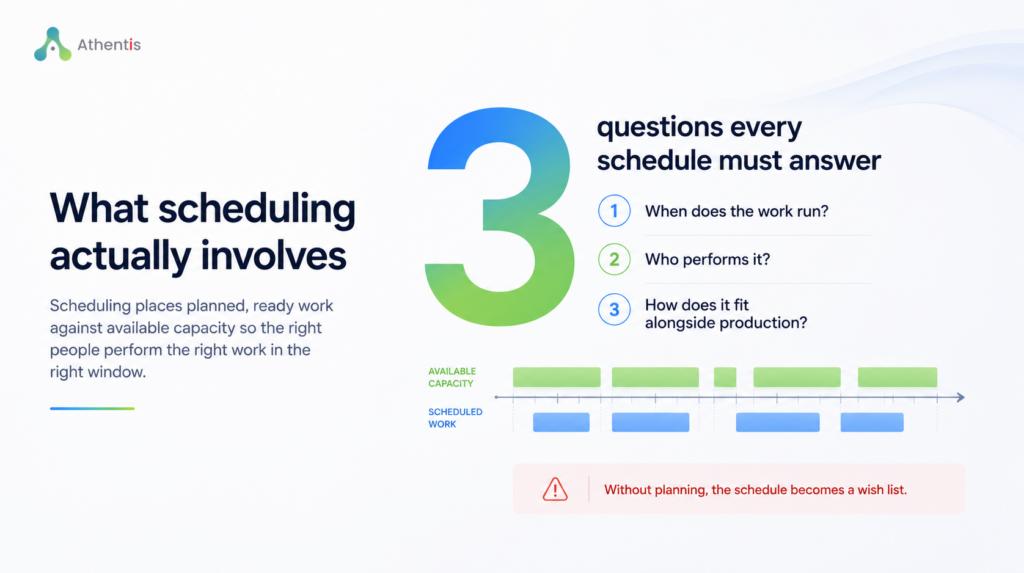
Scheduling takes planned, ready work and places it against available capacity. It answers when the work runs, who performs it, and how it fits alongside production demands, shift patterns, and other outstanding tasks. Done well, scheduling is a sequencing exercise: fitting prepared jobs into the available windows so that people and equipment are used efficiently and production disruption is minimized.
But scheduling depends entirely on the quality of the planning beneath it. You cannot sequence work reliably if you do not know what each job actually requires. When scheduling is performed without planning, the schedule becomes a wish list. Jobs are assigned dates based on urgency or convenience rather than readiness, and the schedule collapses the moment reality intervenes, because the work underneath it was never prepared to begin with. A schedule built on unplanned work is not a plan. It is a forecast of disappointment.
Why collapsing the two is so costly
When planning and scheduling are treated as one, the symptoms are familiar to anyone who has run a maintenance shift. A technician arrives at a job and leaves again to find a part. Work is marked complete and then has to be redone because the scope was misunderstood. Two people are dispatched to a task that needed three, or three to a task that needed one. Wrench time, the proportion of a technician’s paid day actually spent on tools, falls as skilled and expensive staff spend hours chasing materials, drawings, and permits that should have been ready before they walked up to the asset.
None of this registers as a planning failure on a standard report. The schedule was followed. The jobs were attempted. The completion numbers may even look reasonable. What the report does not capture is that the work was scheduled before it was ready, and that the cost of that gap was paid quietly on the floor, in lost hours, duplicated effort, and delayed production. It is one of the most expensive problems in maintenance precisely because it is invisible in the places most organizations look.
What changes when the two are separated
Organizations that distinguish planning from scheduling treat them as sequential steps rather than a single event. Work is planned first, to a defined standard of readiness. Only planned work becomes eligible for the schedule. And a job is not placed on the calendar until its scope, parts, labour, and requirements have been confirmed.
This changes the daily experience of maintenance in ways that compound over time. Technicians arrive to work that is genuinely prepared, so their time on site is spent executing rather than gathering. Schedules hold, because they are built from ready jobs instead of optimistic estimates. Production gains confidence in maintenance windows, because the work starts and finishes when it was supposed to. And planning becomes visible as a discipline in its own right, with its own standard and its own value, rather than being absorbed into scheduling and quietly skipped whenever the day gets busy.
There is a cultural shift as well. When planning is a defined stage, the organization starts to value preparation as much as execution. The question stops being only “did we complete the work” and becomes “was the work ready before we started it,” which is the question that actually determines whether a maintenance program is in control.
The role of the EAM system
An Enterprise Asset Management platform is what makes this separation practical rather than aspirational. In Octave Attune, work can carry a defined planning stage, with parts, labour, and requirements captured against the job before it becomes eligible for scheduling. Standard job plans allow recurring work to be planned once and reused, so readiness does not have to be rebuilt from scratch every time a familiar task comes around. And the schedule can draw from a pool of genuinely prepared work rather than a list of good intentions.
Because planning and scheduling exist as distinct steps in the system, the organization can finally see the difference between work that is ready and work that merely has a date. That visibility is the whole point. It allows a supervisor to protect the planning function instead of watching it disappear under daily pressure, and it allows the maintenance program to move from a schedule that looks orderly on screen to one that actually holds up in the field.
Readiness before timing
A date on the calendar is not the same as a job that is ready to be done. Planning establishes readiness. Scheduling establishes timing. A maintenance program that treats them as one activity will always be caught out at the point of execution, because the preparation that should have happened earlier never had a place in the process to happen at all.
The organizations that get this right are not necessarily planning more work than everyone else. They are planning it before they schedule it. That single distinction, unglamorous as it sounds, is what separates a maintenance function that spends its days reacting from one that genuinely runs.

