
Real-time fleet management is often framed as a visibility challenge. The assumption is that if organizations can see where their assets are, understand how they are performing, and monitor their condition in real time, operational performance will naturally improve.
In practice, most asset-intensive organizations already have some level of visibility in place. Telematics systems track movement, sensors capture equipment condition, and maintenance platforms store operational history. Data is available, often in large volumes.
And yet, performance does not always follow.
Unplanned downtime still occurs. Maintenance remains reactive. Asset utilization fluctuates without a clear explanation. The presence of data does not automatically translate into better outcomes.
This is where the real limitation becomes apparent. The issue is not visibility itself, but the absence of a structured way to turn that visibility into consistent operational control.
Why Visibility Alone Does Not Improve Fleet Performance
It is easy to assume that more data leads to better decisions. In reality, the relationship is less direct.
Fleet operations typically involve multiple functions working in parallel. Maintenance teams respond to system alerts and equipment condition. Operations teams focus on scheduling and availability. Management reviews performance through aggregated reports and financial summaries.
Each group has access to relevant information, but not necessarily within a shared framework. Data exists, but it is interpreted differently depending on context.
As a result, decisions are often made with partial alignment. Maintenance actions may be triggered without full awareness of operational demand. Asset allocation may respond to immediate availability rather than underlying condition. Issues may be identified early but not acted upon with the right level of urgency.
The organization becomes informed, but not coordinated.
Real-time fleet management only begins to deliver measurable value when visibility is embedded into a structure that defines how decisions are made, when they are made, and how different teams act on the same information.
What Real-Time Fleet Management Should Actually Enable
At a structural level, effective fleet management depends on aligning three elements: the condition of the asset, the operational demand placed on it, and the timing of maintenance intervention.
When these elements are managed independently, performance becomes inconsistent. Maintenance may be performed too early or too late. Assets may be overused in one area and underutilized in another. Decisions rely on habit or static planning rather than current conditions.
When these elements are connected, the nature of decision-making changes.
Maintenance becomes condition-driven rather than schedule-driven. Dispatching reflects actual demand rather than assumed availability. Utilization becomes something that can be actively managed rather than passively observed.
At this point, real-time fleet management begins to influence outcomes in a meaningful way. The system is no longer describing what is happening. It is shaping what happens next.
The Architecture Behind Real-Time Fleet Control
Achieving this level of control is not the result of a single system or tool. It depends on a structured architecture that connects physical assets to operational decisions in a consistent and reliable way.
Each layer within this architecture contributes to the transformation of raw data into usable insight and, ultimately, into action.
The Technology Stack Behind Real-Time Fleet Management
Real-time fleet management relies on a continuous flow of information that moves from the asset itself to the point of decision-making. The effectiveness of the system depends on how well each component in this chain is defined and integrated.
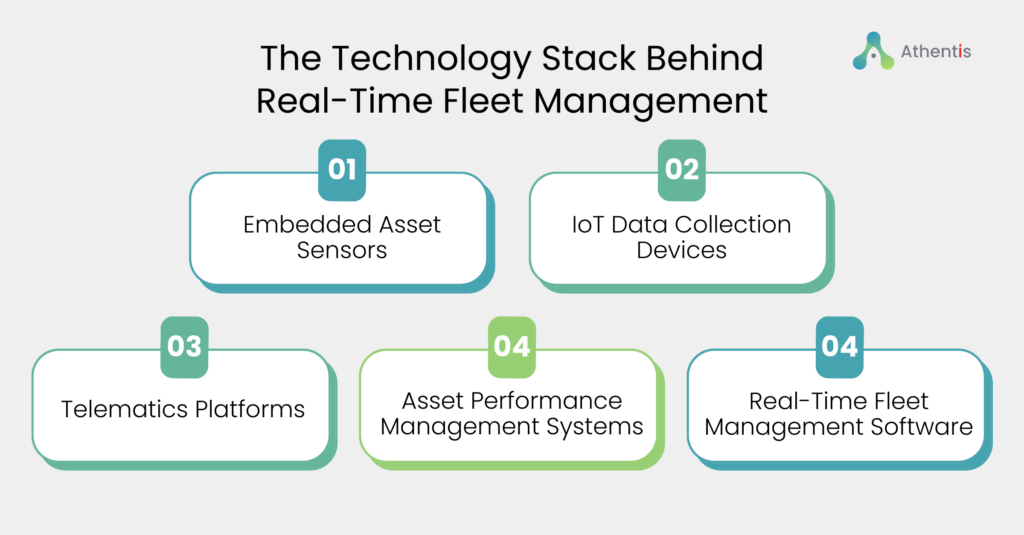
At the foundation are embedded sensors, which capture how assets behave under real operating conditions. Temperature, vibration, load, and runtime provide direct insight into performance and early signs of wear. This data reflects actual usage rather than assumptions.
That data must then be transmitted reliably. IoT data collection devices ensure that information flows continuously from the field without requiring manual input. Without this layer, even high-quality sensor data remains isolated and underutilized.
Telematics platforms add operational context by organizing location, movement, and usage data into a coherent picture of fleet activity. This is where raw signals begin to take on meaning within an operational environment.
From there, asset performance management systems analyze data over time. Patterns become visible, anomalies can be identified, and early indicators of risk begin to emerge. This layer allows organizations to move beyond observation and toward prediction.
Finally, real-time fleet management software connects this insight to action. Workflows are triggered, alerts are generated, and decisions can be made in the moment based on current conditions rather than delayed reporting.
Taken together, this structure enables something far more important than visibility. It enables coordinated response.
The Shift That Matters: Decision Timing
The most significant impact of a well-structured real-time fleet management system is not simply access to information, but the timing of decisions.
In traditional environments, decisions tend to follow events. A failure occurs, a delay is noticed, or a performance issue becomes visible, and only then does action begin. Even when data is available, it often requires manual interpretation, which introduces delay.
In a structured real-time environment, this sequence changes.
Maintenance can be scheduled based on early indicators rather than confirmed failures. Assets can be reassigned before utilization imbalances create operational strain. Service teams can act on emerging conditions rather than reacting to disruptions after they occur.
This shift reduces variability across operations. It also removes a significant portion of the cost associated with urgency, including emergency repairs, unplanned downtime, and inefficient allocation of resources.
Where the Impact Becomes Visible
The benefits of real-time fleet control become most apparent in environments where asset performance directly influences revenue and service delivery.
In rental operations, improved coordination and condition-based decisions increase utilization while reducing idle time and asset loss. In field service organizations, earlier diagnostics and better preparation lead to faster response times and more consistent service outcomes. In logistics and distribution, better alignment between asset condition and operational demand improves throughput and reduces delays.
These improvements are not the result of visibility alone. They come from the ability to act on that visibility in a structured and timely way.
Why HxGN EAM Plays a Central Role
HxGN EAM provides the structure required to connect asset data with operational workflows in a consistent and scalable way.
Asset condition data feeds directly into maintenance planning. Work orders are triggered based on real-world signals rather than static schedules. Asset histories remain complete and continuously updated, supporting both operational decisions and long-term analysis.
When configured correctly, the platform moves beyond tracking maintenance activity. It becomes part of the decision-making process itself, ensuring that asset behavior is reflected in how operations are planned and executed.
Athentis focuses on designing this structure so that systems are aligned with how the organization actually operates. The value is not created by the technology alone, but by how it is configured to support consistent and reliable decision-making across teams.
Final Thoughts
Real-time fleet management is often introduced as an upgrade in visibility. In reality, its value lies in establishing control over complex, asset-driven operations.
Organizations that focus only on collecting and displaying data improve awareness but often remain reactive. Those that build structured systems around that data improve timing, coordination, and consistency across their operations.
The difference is not the amount of information available. It is whether that information is used to make better decisions at the right time.

