
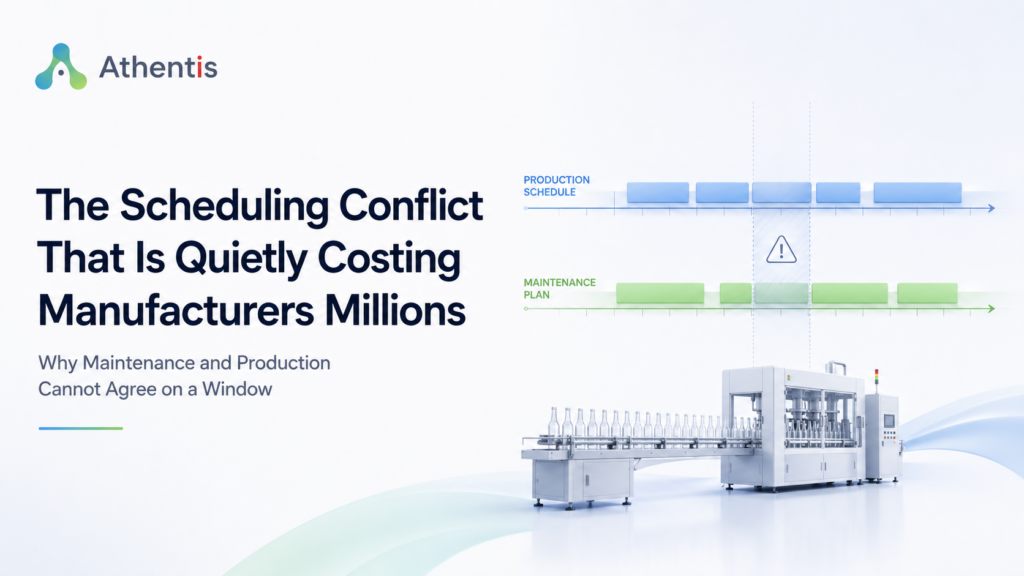
Why Maintenance and Production Cannot Agree on a Window, and What It Costs When They Cannot
In asset-intensive manufacturing environments, two planning functions operate continuously.
Production planning determines what needs to be made, when it needs to be made, and which lines and assets are required to meet the schedule. Maintenance planning determines which assets need servicing, when they need servicing, and how long each intervention will take.
In theory, these two functions should work in close coordination. In practice, in most organizations, they operate in parallel with limited integration and frequent conflict.
The result of that conflict is not obvious in any single budget line. It is distributed across maintenance cost reports, production variance figures, emergency procurement records, and downtime logs in a way that makes the total financial impact difficult to see at once.
But it is substantial.
How the Conflict Typically Develops
The dynamics are familiar to anyone who has worked inside a manufacturing or food and beverage operation.
Maintenance identifies an asset that requires planned intervention. A time window is proposed. Production reviews the schedule and determines that the line cannot be released during that window because demand commitments or production targets cannot accommodate the downtime.
The maintenance window is deferred.
This is a reasonable decision made under real operational pressure. The demand is visible. The cost of not running the line is immediate. The cost of deferring the maintenance is not visible at that moment. It is theoretical.
The asset continues to run. A replacement window is identified, deferred again. The maintenance backlog grows without appearing on any financial report. The asset continues to operate beyond the point at which planned intervention would have been most efficient.
Eventually, the asset fails unexpectedly.
The unplanned failure triggers a different response entirely. The line stops without preparation. Emergency procurement begins. Technicians are pulled from other priorities. Depending on the asset and the production environment, product waste, quality holds, or customer delivery failures may follow.
The cost of that unplanned failure is significantly higher than the cost of the planned maintenance that was deferred. Studies across industrial environments consistently show that unplanned maintenance events cost three to five times more than equivalent planned interventions when the full picture is considered, including labor inefficiency, parts availability premiums, and production impact.
And yet, the decision to defer was made with the best available information at the time, because the cost of deferral was not visible.
Why This Pattern Is So Persistent
The scheduling conflict between maintenance and production is not caused by poor intent on either side. It is caused by a structural problem: the two functions operate from different information, with different priorities, and without a shared view of financial consequence.
Production planning is measured against output, schedule adherence, and delivery performance. The cost of stopping a line for planned maintenance appears immediately and directly in those metrics.
Maintenance planning is measured against completion rates, response times, and backlog levels. The future cost of deferred maintenance does not appear in current maintenance metrics.
Without a shared financial framework that makes the true cost of deferral visible to both functions simultaneously, the decision to defer will consistently favor production, because the cost of running is visible and the cost of deferring is not.
This is compounded by the way most organizations manage maintenance scheduling. Planned maintenance windows are typically negotiated between maintenance supervisors and production managers through informal coordination processes. There is rarely a formal mechanism that quantifies the risk of deferral in financial terms and presents it to both parties before the decision is made.
The result is a pattern that repeats itself across manufacturing environments: planned maintenance is deferred under production pressure, backlogs accumulate, failure risk increases, and eventually an unplanned event occurs at a cost that exceeds the original planned intervention by a significant margin.
What the True Cost of the Conflict Includes
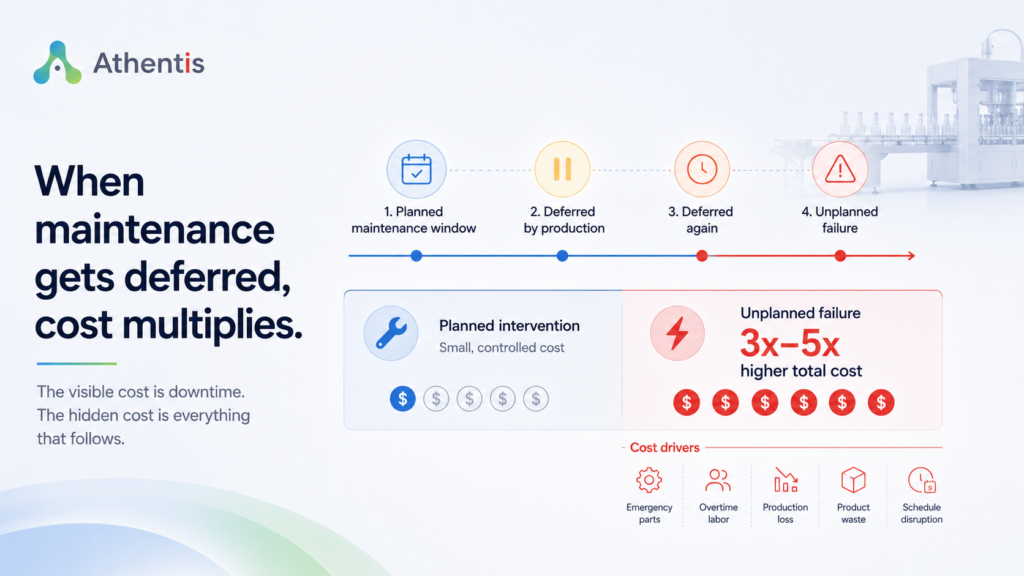
When the full financial picture of the maintenance-production scheduling conflict is assembled, it typically includes several elements that are rarely connected to their common source.
Emergency procurement costs. When an unplanned failure requires immediate parts, standard purchasing windows disappear. Emergency sourcing premiums, priority freight charges, and the cost of subcontracted emergency labor all add to the event cost in ways that planned maintenance would not have generated.
Production loss and schedule disruption. An unplanned line stoppage affects not just the immediate production run but downstream scheduling, order commitments, and sometimes customer relationships. These costs appear in commercial and operational reports rather than maintenance budgets.
Product waste. In food and beverage environments particularly, a production line failure mid-run can result in product that cannot be completed, held, or released. Depending on the point in the production cycle, this waste can represent significant direct cost.
Compliance exposure. In regulated production environments, an unplanned equipment failure may trigger hygiene resets, quality holds, or documentation requirements that consume time and resources beyond the immediate maintenance response.
Technician overtime and productivity loss. Emergency response pulls technicians away from planned work, compresses schedules, and frequently requires overtime. This adds labor cost while simultaneously reducing overall maintenance productivity.
Increased wear on related assets. When a failure in one part of a production system causes others to operate at altered loads or under abnormal conditions, wear patterns across connected assets can accelerate in ways that are difficult to attribute directly to the original event.
None of these costs are invisible once they occur. But they are attributed to the events themselves rather than to the scheduling decisions that preceded them.
What a Connected EAM Environment Changes
The maintenance-production scheduling conflict is ultimately an information problem. Both functions are making reasonable decisions with the information available to them. The information available to each is incomplete.
A well-structured EAM environment changes this by creating a shared operational picture that both maintenance and production planning can draw from.
When asset criticality is defined clearly within the EAM system, the risk consequence of deferring maintenance on any specific asset becomes quantifiable. Not all assets carry the same consequence of failure. A cooling system on a critical production line carries a different risk profile than a secondary conveyor in a non-critical area. When criticality is structured into the system, deferral decisions can be weighted against real risk rather than treated uniformly.
When maintenance backlog is visible alongside asset condition data, the decision to defer is made with a clearer picture of cumulative risk. A first deferral may be low risk. A third deferral on the same asset, against a background of increasing failure indicator frequency, is a materially different decision. That distinction requires structured data to make visible.
When planned maintenance is linked to the production schedule inside an integrated planning framework, both functions can see the same picture. Production planners can identify maintenance windows within their schedule with greater precision. Maintenance planners can propose interventions that fit around genuine production commitments rather than negotiating around assumptions.
When the cost of previous unplanned failures is recorded and attributed to specific assets and asset classes, the financial argument for protecting maintenance windows becomes concrete rather than theoretical. The conversation shifts from “we cannot afford to stop the line” to “the last time we deferred maintenance on this asset, the failure cost us significantly more than this window would.”
The Role of Octave Attune
Octave Attune provides the structure required to support this kind of connected planning.
Asset criticality frameworks allow maintenance priorities to be aligned with operational consequence rather than simple urgency. Work order scheduling tools allow maintenance windows to be planned in coordination with production demand rather than in isolation from it. Failure history and cost attribution enable the true cost of previous unplanned events to be visible at the asset level, creating a financial reference point for future deferral decisions.
When configured to support the integration of maintenance and production planning, the platform reduces the information gap between the two functions. Decisions about maintenance windows are made with a clearer picture of asset condition, failure risk, and the financial consequence of deferral.
This does not eliminate the tension between production demand and maintenance requirements. That tension is inherent to manufacturing operations.
It does mean that tension is managed with better information on both sides.
Why This Is Particularly Relevant in Food and Beverage
The maintenance-production scheduling conflict carries additional consequences in food and beverage manufacturing that are worth addressing directly.
Production schedules in food and beverage are shaped not only by customer demand but by product shelf life, raw material availability, batch sequencing, and regulatory requirements. These constraints reduce scheduling flexibility significantly compared to many other manufacturing environments.
At the same time, equipment failures in food and beverage carry specific consequences beyond production loss. Temperature deviations, contamination risk, and hygiene protocol restarts can result in product holds, quality investigations, and regulatory notifications that extend the impact of a single failure event well beyond the immediate repair.
In this environment, the cost of deferred maintenance is higher and the recovery from unplanned failure is more complex. The financial case for protecting planned maintenance windows is correspondingly stronger.
For food and beverage operators, the investment in connecting maintenance planning to production scheduling is not a theoretical improvement. It is a direct mechanism for reducing one of the most consistent sources of operational cost and regulatory exposure.
The Role of Athentis
Athentis works with manufacturing and food and beverage organizations to structure their EAM environments in a way that supports better coordination between maintenance and production planning.
This involves defining asset criticality in operational terms, configuring maintenance scheduling tools to reflect real production constraints, and building the data structures that allow failure cost history to inform future planning decisions.
The objective is to reduce the gap between what maintenance knows about asset condition and what production understands about the cost of deferring intervention.
When that gap closes, the scheduling conflict that generates unnecessary cost in so many industrial organizations begins to resolve itself through better decisions rather than through organizational pressure.
The conflict between maintenance planning and production scheduling is one of the most consistent sources of avoidable cost in manufacturing and food and beverage operations.
It persists not because organizations lack discipline or intent, but because the two functions operate without a shared view of what deferred maintenance actually costs. The cost of running the line is visible. The cost of deferring maintenance is distributed across future events that are difficult to connect back to the original decision.
When EAM environments are structured to make that connection visible, the nature of the scheduling conversation changes. Maintenance windows are protected more consistently. Planned intervention replaces unplanned failure as the dominant maintenance mode. The financial difference between the two begins to show up in costs that matter.
The organizations that get this right are not those with the most aggressive maintenance programs.
They are the ones that have built the information structures that allow maintenance and production to make better decisions from the same picture.

