
What repeat repairs reveal about the difference between completed work and restored reliability
A closed work order is one of the cleanest signals in a maintenance system. The labour has been entered, the parts have been issued, the job has moved off the schedule, and the backlog has fallen by one. From a reporting point of view, the work is finished.
Then the same asset fails again. Sometimes the fault returns after a few shifts. Sometimes it appears several weeks later under the same operating conditions. A new work order is raised, another technician is assigned, and the organisation pays for the same interruption again without necessarily recognising it as repeat work.
This is rarely explained by a lack of effort. In many cases, the original repair was completed exactly as requested. The deeper problem is that work order closure is being used to confirm that activity took place, rather than to confirm that reliability was restored. Those are different standards, and the gap between them can hide inside apparently strong maintenance performance for years.
A closed work order can hide an open problem
Maintenance teams often have to make practical decisions under pressure. A production line needs to restart, a customer commitment is at risk, or a critical service has to be restored. The immediate task is to return the asset to operation, and a temporary correction may be entirely justified.
The difficulty begins when the system records that temporary correction as the final solution. A trip is reset without identifying why it occurred. A leaking seal is replaced without checking alignment or operating conditions. A damaged component is changed, while the contamination, vibration, loading or installation issue that damaged it remains in place. The asset runs again, so the work order is closed, yet the original cause is still active.
Every individual repair can look successful when viewed on its own because the technician attended quickly, the part was replaced and the equipment restarted. The work order may also have met its target date. Only the history of repeated interventions reveals that the organisation is restoring function without removing the reason it was lost.
Why repeat work costs more than the repair itself
The visible cost of a repeat failure is straightforward: more labour, another part and another period of downtime. The wider cost includes a second isolation, another change to the production plan, and the repeated organisation of permits, access equipment or contractor support. Planners and supervisors repeat work they believed had already been completed, while another planned job is pushed aside to create capacity.
These costs are often spread across separate records and budget lines. The first repair may sit in one month and the second in the next. Emergency freight may appear under procurement, lost output under production variance, and overtime under labour. Each figure looks manageable in isolation. Together, they show that the same fault has been purchased more than once.
Standard maintenance indicators do not always expose this clearly. Mean time to repair may improve because each intervention is completed quickly, schedule compliance may remain strong, and the number of closed work orders may even be celebrated. None of those measures answers the more important question: did the asset remain reliable after the work was completed?
The strongest evidence exists at the end of the job
The best moment to capture what happened is while the technician is still at the asset, with the failed component visible, the operating conditions fresh in memory, and measurements, photographs and observations still connected to the exact work performed. Once the technician returns to the workshop and moves to the next job, much of that detail is reduced to a short comment or a generic code.
A useful closure record should explain the problem that was found, the cause that is believed to have created it, and the action taken to correct it. It should also record the actual parts and labour used, relevant readings before and after the repair, and any remaining concern that requires follow-up. When the cause is not yet known, the record should say so clearly rather than presenting a quick assumption as a confirmed diagnosis.
This does not require technicians to write long reports after every task. It requires a closure process that asks a small number of precise questions and makes them easy to answer at the point of work. A short, accurate record captured immediately is more valuable than a detailed reconstruction attempted several days later.
Completion needs a clear acceptance test
For critical work, the definition of complete should be decided before the job begins. Replacing a component is an action. It is not proof that the asset is ready to return to service. The proof may be a pressure test, a vibration reading, a temperature check, a safety interlock test, a leak inspection, a production quality check or a defined period of stable operation.
Without an acceptance standard, closure becomes subjective. One technician may consider the job complete when the equipment starts. Another may wait until it has run under load. Operations may accept the asset because production needs it, even though a warning sign remains. When these expectations are not written into the job plan, the organisation cannot distinguish between a fully verified repair and a restart that still carries unresolved risk.
The right test depends on the equipment and the consequence of failure. A minor facility repair should not carry the same closure burden as work on a critical production asset. The principle is consistent: the level of verification should match the risk, and the evidence should remain attached to the work order.
Temporary repairs must remain visible
Temporary work is a normal part of maintenance. What creates risk is allowing temporary work to disappear into a closed status with no controlled next step. A patch, bypass or short-term component substitution may keep the operation safe until a planned window becomes available. If the permanent correction is not created and linked immediately, the temporary state can remain in place far longer than anyone intended.
A strong process separates restoration from resolution. The first work order records what was done to return the asset to service and identifies the limitations of that action. A linked follow-up work order carries the permanent repair, engineering review or root cause investigation into the backlog with an owner, priority and due date. This preserves operational flexibility without losing control of the remaining risk.
The distinction also protects the technician. The record shows that the immediate response was appropriate for the situation and that the unresolved work was handed forward deliberately. Without that structure, the same technician may later appear to have performed an incomplete repair when the real failure was that the organisation never managed the follow-up.
What the EAM system should make visible
Octave Attune EAM, formerly HxGN EAM, can bring this discipline into the normal work process. Work order closure can capture field observations, problem, failure, cause and action codes, actual labour and materials, comments, measurements and supporting attachments. Mobile access allows this information to be recorded at the asset, while linked work orders and asset history make repeat interventions easier to recognise.
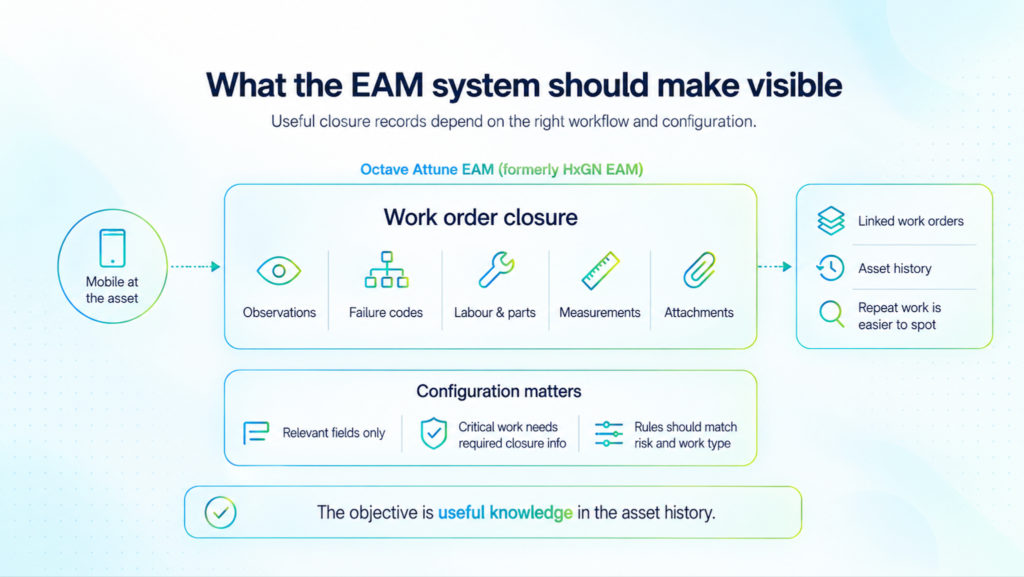
Configuration determines whether those capabilities produce useful records. If every work order presents a long list of irrelevant fields, users will choose the fastest option and data quality will fall. If important closure information is optional on critical work, records will remain incomplete whenever the day becomes busy. Closure rules should reflect asset criticality, work type and the evidence needed to confirm a safe return to service.
Athentis helps organisations design these workflows around the way maintenance is actually performed. That includes defining practical closing codes, building acceptance checks into job plans, creating controlled follow-up routes and reporting on repeated corrective work. The objective is not to add administration. It is to ensure that closing a work order adds useful knowledge to the asset history instead of hiding the next failure.
Measure whether the repair held
The most useful review is not simply how many corrective work orders were closed. It is how many assets required another corrective intervention for the same or a closely related problem within the following weeks or months. That view can be supported by repeat failure reports, linked work order history, cause and action data, and the time the asset operated successfully after repair.
Other measures help explain the pattern: the proportion of critical work orders with a completed acceptance test, the number of temporary repairs with overdue follow-up, and the percentage of closures where cause and action were recorded clearly. These indicators should be used to improve job plans, technical support and maintenance strategy, rather than to punish technicians for difficult work.
When a repeat failure is visible, the organisation can learn from it. The repair method may need to change. A standard job plan may be incomplete. A spare part specification may be wrong. Operating conditions may be damaging the equipment. The preventive programme may be addressing the symptom instead of the failure mechanism. Each repeated intervention is evidence, provided the system preserves enough detail to connect the events.
Close the job only when the learning is captured
Work order closure is often treated as the final administrative step in maintenance. In reality, it is the point where field experience becomes part of the organisation’s future decision-making. A weak closure confirms that someone attended. A strong closure explains what was found, what was changed, how the result was verified and what still needs to happen.
The difference becomes visible over time. Assets fail less often for the same reason, temporary repairs remain visible until the permanent work is completed, and job plans improve because real feedback reaches the planner. Maintenance history becomes useful to the next technician rather than a sequence of dates and generic comments.
A work order should leave the operation with two outcomes: an asset that is ready to perform and a record that makes the next decision better. When only the first is attempted, the same failure has a habit of coming back.

