
Predictive maintenance for distribution is rapidly becoming essential in a market where margins are thin and expectations are high. Modern distribution centers operate at the intersection of speed, technology, and precision, where even minor equipment downtime can trigger delayed orders, missed SLAs, and loss of customer trust.
As distribution networks grow more automated, the cost of reactive or time-based maintenance increases. Predictive maintenance, powered by tools like HxGN EAM, uses real-time data, sensors, and AI to forecast failures before they happen. This approach not only prevents disruptions but safeguards the continuous flow of goods, operations, and revenue.
In this blog, we’ll explore how predictive maintenance is transforming the distribution landscape, improving uptime, optimizing resource allocation, and strengthening customer confidence. You’ll also learn how Athentis helps distributors move from reactive firefighting to proactive performance through intelligent, data-driven asset management.
Let’s begin!
Why Reactive Maintenance No Longer Works
Predictive maintenance for distribution is quickly replacing outdated reactive approaches and for good reason. In fast-paced distribution environments, unplanned downtime doesn’t just slow operations; it disrupts customer commitments and eats into already tight margins. Waiting for a failure to occur often leads to last-minute scrambles, delayed deliveries, and SLA violations that damage trust and revenue alike.
Reactive maintenance also drives hidden costs: emergency callouts from external technicians come at a premium, and spare parts are overstocked “just in case,” tying up capital and warehouse space. The unpredictability puts strain on internal teams, who are forced into firefighting mode instead of executing planned, high-value work.
Perhaps most damaging, reactive strategies shorten the lifespan of critical equipment. When maintenance is delayed until breakdown, repairs are often rushed or incomplete, leading to premature wear and increased asset turnover. In contrast, predictive models extend asset life by ensuring interventions happen at precisely the right time. For modern distribution networks, staying reactive simply isn’t sustainable.
The Business Case for Predictive Maintenance
For distribution leaders, the shift to predictive maintenance is more than a technical upgrade, it’s a bottom-line strategy. Predictive models powered by real-time data and AI can dramatically improve operational performance, reduce avoidable costs, and extend the life of critical systems. When uptime drives customer satisfaction and efficiency, every asset decision becomes a business decision.
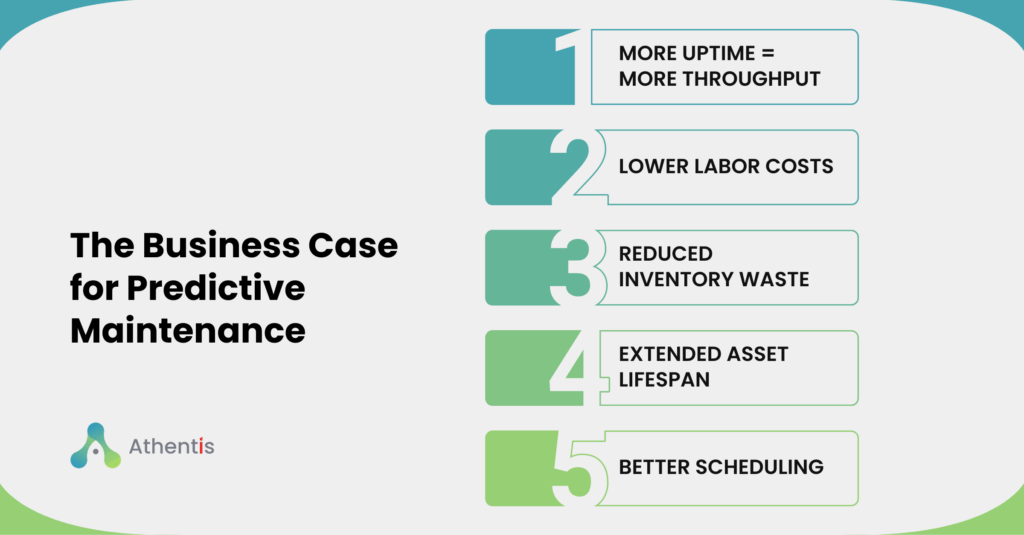
More Uptime = More Throughput
Every minute of downtime impacts the flow of goods. A conveyor failure that halts picking and packing for three hours can result in hundreds of missed shipments. Predictive maintenance ensures assets stay operational during peak fulfillment, protecting throughput and delivery promises.
Lower Labor Costs
Reactive failures require emergency coverage, often leading to overtime costs or outsourced service calls. Predictive maintenance enables scheduled interventions during normal working hours, giving teams more stability and control over workloads.
Reduced Inventory Waste
When equipment fails mid-process, products may spoil, get damaged, or be misrouted, especially in temperature-controlled or high-velocity environments. Predictive maintenance prevents these errors by catching failures before they disrupt inventory flow.
Extended Asset Lifespan
Assets degrade over time, but catastrophic failures accelerate wear and tear. Predictive insights help teams act before critical components fail, reducing the need for full replacements and extending asset ROI.
Better Scheduling
Predictive models let operations align maintenance windows with low-demand periods. This ensures minimal disruption during high-volume cycles and improves coordination across planning, staffing, and inventory teams.
The business case is clear: predictive maintenance increases reliability, cuts costs, and keeps operations moving. For distribution environments where precision is everything, it’s not just an upgrade, it’s a competitive necessity.
Real-World Results with HxGN EAM
Predictive maintenance becomes truly powerful when it’s connected to real-world outcomes. At Athentis, we’ve helped distribution clients implement HxGN EAM to reduce downtime, improve response times, and gain complete control over asset performance. From predictive insights to automated workflows, these solutions drive measurable impact where it counts most, on the warehouse floor.
28% Fewer Unplanned Stoppages in 6 Months
- One distribution client implemented HxGN EAM’s predictive modules across its conveyor and sorting systems.
- Within six months, they saw a 28% reduction in unplanned stoppages, improving fulfillment rates and reducing labor strain during peak hours.
Smarter Alerts, Faster Response
- With real-time sensor data feeding into HxGN EAM, asset health anomalies automatically trigger alerts.
- Technicians receive mobile work orders instantly, allowing them to diagnose and act before disruptions occur, cutting lag time and boosting maintenance efficiency.
Seamless Integration with PLCs and Sensors
- HxGN EAM integrates with programmable logic controllers (PLCs), vibration sensors, and temperature monitors to track conditions across warehouse assets.
- This sensor-driven architecture ensures accurate forecasting and targeted interventions for every key component.
Connected to WMS for Full Operational Visibility
- For distribution clients, HxGN EAM can be integrated with warehouse management systems (WMS) to coordinate asset status with inventory flow.
- If a picking system shows signs of failure, inventory tasks can be automatically rerouted, avoiding workflow disruptions.
Scalable Across Facilities and Fleets
- HxGN EAM isn’t limited to a single facility.
- Clients use it to monitor asset performance across regional hubs, linking data from forklifts, HVAC units, and packaging lines into one unified dashboard for enterprise-level control.
These real-world examples show that predictive maintenance isn’t just theory, it’s execution. With HxGN EAM, Athentis helps clients transform distribution reliability into a strategic advantage.
The Future: Predictive + Prescriptive + Autonomous
Predictive maintenance is just the beginning. As technologies mature, distribution operations are moving toward prescriptive and even autonomous maintenance models, where not only are failures predicted, but the next best action is recommended or even executed automatically. This progression is central to the HxGN EAM roadmap, giving clients a tiered path to smarter, more self-directed operations.
- Predictive, Knowing When to Act: Predictive maintenance uses real-time data and analytics to identify when an asset is likely to fail. This eliminates guesswork and allows teams to plan interventions before disruptions occur, maximizing uptime and reducing surprises.
- Prescriptive, Knowing What to Do: Prescriptive models go a step further by recommending the exact response to a predicted issue. Whether it’s replacing a part, recalibrating a sensor, or reallocating equipment, the system advises technicians on the optimal next move.
- Autonomous, Triggering the Action Automatically: In advanced implementations, the system not only predicts and prescribes, it executes. Work orders are triggered automatically, inventory is adjusted, and resources are scheduled without human input, creating a closed-loop maintenance system.
- Multi-System Coordination: These capabilities depend on deep integration across WMS, IoT sensors, ERP systems, and mobile tools. HxGN EAM already supports this ecosystem-level connectivity, positioning clients to evolve at their own pace toward autonomous operations.
- A Roadmap for Scalable Maturity: Athentis helps clients match their current state with the right level of automation. Whether you’re starting with predictive alerts or aiming for full autonomy, the roadmap is flexible, scalable, and aligned to real business value.
The future of maintenance in distribution isn’t just proactive, it’s intelligent and self-sustaining. With the right tools and roadmap, predictive today becomes autonomous tomorrow.
Final thoughts
Predictive maintenance for distribution is no longer optional. In an environment where speed, uptime, and accuracy drive margins, reactive strategies simply can’t keep up. Tools like HxGN EAM help shift maintenance from a cost center into a margin-protecting, performance-driving advantage.
If your teams are still chasing breakdowns or relying on fixed schedules, it’s time to reassess. Start with a diagnostic or platform audit to identify where predictive workflows can reduce downtime, streamline maintenance, and free up resources for higher-value work.

