

And What That Costs in Capital Decisions
In asset-intensive organizations, large volumes of data are collected every day. Maintenance histories, inspection records, failure reports, and condition monitoring data all flow through systems like HxGN EAM with increasing accuracy and consistency.
At an operational level, this data is essential. It supports maintenance planning, ensures compliance, and helps teams keep assets running.
At an executive level, however, a different reality often exists.
Capital investment decisions are still frequently based on age-based assumptions, budget cycles, or high-level summaries. Maintenance trends are discussed, but not always deeply analyzed. Asset performance is acknowledged, but not always translated into financial terms.
The data exists. The systems are in place.
Yet the connection between asset reality and executive decision-making remains weaker than expected.
The Disconnect Between Asset Reality and Capital Planning
In many organizations, asset management and financial planning operate in parallel rather than in alignment.
Maintenance teams work with detailed, asset-level information. They understand which equipment is failing more frequently, which assets require increasing intervention, and where operational risk is growing.
Finance teams work with aggregated views. Capital planning often relies on:
- Depreciation schedules
- Replacement cycles
- Historical cost patterns
These models are necessary, but they do not always reflect current asset behavior.
As a result:
- Assets are replaced too early because their true condition is unclear
- Assets are kept too long because emerging risks are not visible
- Investment decisions rely on assumptions rather than evidence
The issue is not the lack of data. It is the lack of translation.
Why Asset Data Rarely Influences Executive Decisions
The assumption is that once data exists in an EAM system, it will naturally support better decisions. In reality, several structural barriers prevent this.
1. Data fragmentation
Even strong EAM environments often operate separately from financial systems and planning tools. Insights remain localized.
2. Inconsistent structure
Asset hierarchies, failure codes, and maintenance records vary across sites, making comparison difficult.
3. Lack of interpretation
Raw data does not produce decisions on its own. Without structured analysis, leadership relies on summaries or experience.
Over time, this creates a gap where:
- Operations trust the data
- Leadership trusts the model
- The two are not fully aligned
From Asset Records to Financial Insight
For asset data to influence capital decisions, it must move beyond recording activity and begin supporting evaluation.
This means connecting:
- Maintenance history → cost trends
- Failure patterns → risk exposure
- Downtime → financial impact
- Asset condition → remaining useful life
When structured correctly, asset data starts answering critical questions:
- What is the real cost of continuing to operate this asset?
- How does it compare across sites or asset classes?
- What is the financial impact of failure risk?
- When does replacement become the better decision?
These are not maintenance questions.
They are business decisions.
The Role of EAM in Capital Planning
Platforms like HxGN EAM already contain much of the required information.
The challenge is not data availability. It is alignment.
When configured correctly:
- Work orders become cost signals
- Inspection results reveal degradation patterns
- Asset histories support lifecycle analysis
- Maintenance trends inform capital strategy
At this point, EAM evolves from:
→ a maintenance system
into
→ a decision-support system
What Changes in Organizations That Get This Right
When asset data is properly connected to decision-making, several shifts occur.
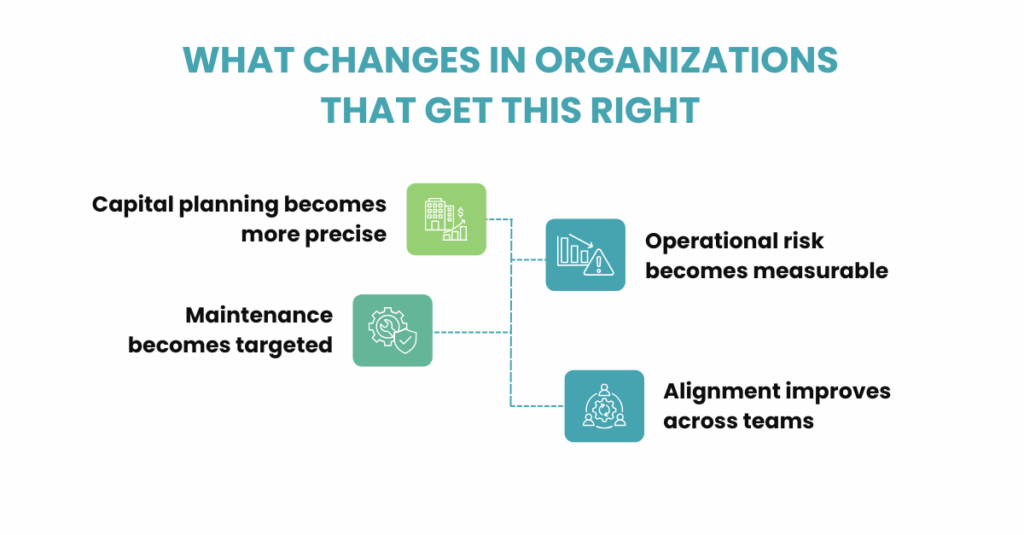
Capital planning becomes more precise
Decisions are based on condition and cost, not just age.
Operational risk becomes measurable
High-risk assets are identified and prioritized clearly.
Maintenance becomes targeted
Resources are allocated based on need, not uniform schedules.
Alignment improves across teams
Operations and finance work from the same understanding.
This does not eliminate uncertainty.
But it significantly reduces reliance on assumption.
The Role of Athentis
At Athentis, the focus is not only on implementing EAM systems, but on ensuring that the data within those systems supports real decisions.
This includes:
- Structuring asset hierarchies to reflect operational and financial realities
- Standardizing data across sites and asset classes
- Aligning EAM outputs with reporting and capital planning processes
The goal is simple.
To ensure that asset data becomes part of how organizations evaluate cost, risk, and investment.
Final Thoughts
Most organizations have already invested in collecting asset data.
The remaining challenge is not technological. It is structural.
If asset data stays within maintenance, its value remains limited.
If it reaches decision-makers, it becomes one of the most powerful inputs an organization has.
The question is not whether the data exists.
The question is whether it is shaping the decisions that matter.

