
The Structural Weakness Inside Most EAM Environments
Enterprise Asset Management is no longer a differentiator. It is infrastructure.
Across manufacturing, energy, utilities, infrastructure, and transport, digital maintenance platforms such as HxGN EAM are already deployed. Asset hierarchies exist. Work orders are processed electronically. Preventive programs are automated. Inspection records are logged and stored.
On the surface, maturity appears established.
Yet in 2026, a more fundamental question is emerging across asset-intensive organizations:
Is the system supporting operational discipline, or is it merely documenting activity?
This distinction is becoming increasingly consequential.
EAM Implementation Has Reached Saturation. Governance Has Not.
Over the past decade, organizations invested heavily in digitizing maintenance workflows. The objective was clear: eliminate paper, increase visibility, centralize data, and standardize processes.
That objective has largely been achieved.
The challenge now is not digitalization. It is structural coherence.
Many organizations operate EAM environments where:
• Asset criticality exists but is not periodically recalibrated
• Preventive strategies remain unchanged despite evolving operating conditions
• Failure coding lacks consistency across facilities
• Approval workflows function technically but do not reflect real risk accountability
• Maintenance cost data is available but not fully integrated into lifecycle modeling
The system works. The structure beneath it does not always evolve with the business.
When governance does not mature alongside technology, the organization accumulates operational inertia disguised as stability.
The 2026 Threshold: Defensibility
What has changed in recent years is not merely technology capability. It is the threshold for defensibility.
Regulatory bodies expect traceable inspection logic.
Insurance providers assess maintenance governance as part of underwriting.
Executive boards scrutinize capital allocation with increasing precision.
Sustainability reporting requires verifiable links between asset condition and performance outcomes.
Under these pressures, it is no longer sufficient to demonstrate that maintenance occurred. Organizations must demonstrate that maintenance logic is structured, risk-aligned, and economically sound.
An EAM system that records activity but does not enforce disciplined decision architecture cannot meet this standard.
Defensibility is now the benchmark of maturity.
Where Structural Weakness Typically Appears
Structural weakness in EAM environments rarely manifests as system failure. It appears as gradual misalignment.
Asset hierarchies may reflect historical plant structures rather than current operational models. As production priorities shift or facilities expand, classification schemes remain static.
Criticality models may have been defined during initial implementation but are rarely reassessed against changing business impact. Over time, the distinction between “high” and “medium” critical assets loses practical meaning.
Preventive maintenance tasks often persist based on legacy templates. While they may satisfy compliance requirements, they are not always validated against actual failure trends captured within the system.
Failure coding inconsistencies accumulate silently. Small variations in terminology reduce the reliability of trend analysis, particularly in multi-site organizations.
None of these weaknesses are dramatic. They are incremental. But collectively, they erode the strategic reliability of the EAM environment.
Data Integrity as a Strategic Asset
In advanced asset-intensive organizations, data discipline is treated as a strategic priority rather than a technical configuration issue.
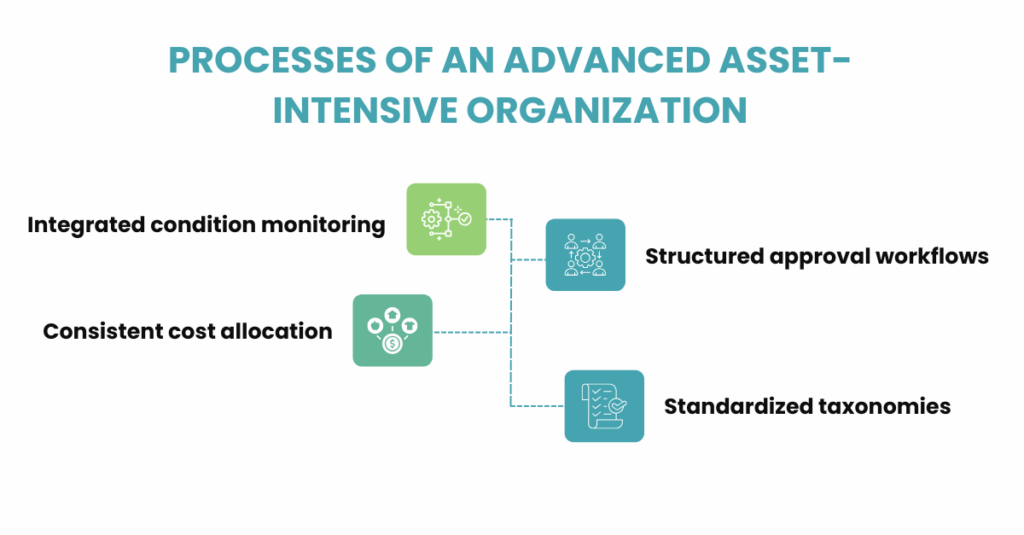
Standardized taxonomies enable meaningful cross-facility comparison.
Structured approval workflows create traceable accountability.
Consistent cost allocation allows accurate lifecycle modeling.
Integrated condition monitoring supports evidence-based intervention timing.
When these elements are aligned within HxGN EAM, the platform transitions from a maintenance repository to a decision-support architecture.
Executives can evaluate asset portfolios based on risk exposure, cost trajectory, and performance degradation patterns rather than intuition or historical precedent.
Finance teams gain visibility into the economic implications of maintenance strategy. Compliance functions operate with confidence that documentation integrity is embedded rather than assembled.
This transformation is subtle in implementation but substantial in impact.
The Economic Consequence of Structural Drift
Asset-intensive industries operate within constrained margins influenced by uptime, energy efficiency, and capital precision.
When structural weaknesses remain unaddressed, financial consequences accumulate gradually.
Maintenance budgets appear controlled while replacement cycles shorten due to unmanaged wear.
Energy inefficiency increases operating cost without triggering immediate alarms.
Capital projects are justified through age-based assumptions rather than performance evidence.
Audit preparation requires reconstruction rather than retrieval.
The organization continues functioning. But its asset governance becomes progressively reactive.
In volatile economic conditions, reactivity increases exposure.
Why HxGN EAM Is Central — and Why Configuration Matters
HxGN EAM provides the technical foundation required for structured asset governance. It supports detailed asset hierarchies, inspection management, work history traceability, cost analysis, and condition-based maintenance.
However, capability does not automatically produce coherence.
The effectiveness of an EAM environment depends on governance design:
• Are asset hierarchies aligned with financial reporting structures?
• Does criticality influence approval thresholds and budget visibility?
• Are failure codes standardized and enforced consistently?
• Is lifecycle cost analysis embedded into capital planning processes?
• Are review cycles structured to evaluate preventive effectiveness?
When these questions are addressed deliberately, the system becomes a strategic control framework.
When they are left implicit, the system remains operationally active but strategically limited.
A Higher Definition of Maturity
In 2026, maturity in Enterprise Asset Management should be defined by the organization’s ability to defend its decisions under scrutiny.
If required, can the organization demonstrate why a specific asset remains in service despite age?
Can it show how preventive strategies evolved in response to trend analysis?
Can it quantify the economic impact of deferred intervention?
Can it provide regulators or insurers with structured, time-stamped documentation without manual reconstruction?
These capabilities define maturity more accurately than maintenance completion rates.
They reflect governance depth rather than procedural activity.
The Role of Athentis
Athentis works with organizations that recognize this structural threshold.
Our approach centers on strengthening governance architecture within HxGN EAM environments. That includes refining asset hierarchies, recalibrating criticality models, standardizing failure taxonomies, aligning cost structures, and embedding lifecycle analysis into executive reporting.
The objective is not system expansion. It is structural clarity.
When governance and configuration align, EAM becomes more than a digital logbook. It becomes a disciplined framework supporting operational resilience, financial precision, and regulatory confidence.
Final Perspective
Enterprise Asset Management has matured technologically. The next stage of maturity is structural.
Organizations that invest in governance discipline will operate with greater defensibility and reduced volatility. Those that rely on functional but static configurations will continue experiencing subtle misalignment between data and decision-making.
The difference will not always be visible immediately. But over time, it will define which asset-intensive organizations operate with strategic control and which operate with procedural comfort.
In 2026, that distinction matters.

