
In most asset-intensive organizations, the conversation about maintenance sounds healthy. Preventive plans are defined. Work orders are closed. Inspections are completed. A platform such as HxGN EAM is in place. On paper, the structure exists.
And yet, when something significant happens, an unexpected failure, a regulatory inspection, a major capital review, the organization often realizes that it does not truly operate from a position of control. It operates from a position of documentation.
That distinction matters more in 2026 than it ever has.
Across Europe, regulatory expectations have tightened. Energy performance is being scrutinized more carefully. Insurance markets are asking deeper operational questions. Capital allocation is under pressure. In this environment, asset management cannot simply prove that work was done. It must prove that decisions were correct.
The difference between those two states is asset governance.
Maintenance activity is not the same as asset strategy
Many organizations equate high maintenance completion rates with maturity. That assumption is comfortable and dangerous.
A mature asset strategy answers harder questions:
- Are we maintaining the right assets at the right frequency?
- Are we replacing assets based on risk and lifecycle evidence, not habit?
- Do we understand the financial exposure of each critical asset?
- Can we defend our capital and maintenance decisions under audit or insurance review?
If those answers require interpretation, tribal knowledge, or spreadsheet reconstruction, the strategy is not yet mature.
Asset-intensive environments today require more than preventive schedules. They require structured intelligence that connects operations, finance, compliance, and risk management into a coherent model.
Where executive misalignment begins
At executive level, three perspectives dominate asset discussions.
Operations focuses on uptime and reliability.
Finance focuses on capital efficiency and cost predictability.
Compliance focuses on documentation, safety, and traceability.
In many organizations, these perspectives coexist without being structurally aligned. The maintenance system may track work accurately, but financial planning does not fully reflect asset condition. Capital budgets may assume fixed replacement cycles that ignore performance data. Compliance documentation may be technically complete but operationally fragmented.
The result is subtle friction:
- Assets are replaced too early because risk is not quantified.
- Assets are replaced too late because lifecycle trends are not visible.
- Budget discussions rely on averages rather than asset-level evidence.
- Audit preparation becomes a coordinated effort instead of a continuous state.
This is not a software limitation. It is a governance design issue.
The shift from recording work to governing assets
True asset governance begins with structure.
Criticality must be defined in business terms, not technical preference.
Asset hierarchies must reflect operational and financial realities.
Lifecycle cost must be visible across acquisition, maintenance, downtime, and disposal.
Approval workflows must create traceable accountability.
When these elements are aligned inside a platform like HxGN EAM, asset management evolves from operational logging to strategic control.
Work orders become more than task records. They become financial inputs.
Condition monitoring becomes more than alerts. It becomes capital planning evidence.
Inspection logs become more than compliance artifacts. They become defensible proof of risk mitigation.
The organization moves from reacting to events to governing exposure.
Why this matters more in 2026
Several structural pressures have elevated asset governance to executive importance.
Regulatory scrutiny has intensified, especially around safety, environmental performance, and documentation integrity. Organizations must demonstrate consistent, traceable processes rather than rely on procedural intent.
Energy efficiency has become financially material. Asset condition directly affects consumption, and inefficient equipment erodes margin and sustainability commitments simultaneously.
Insurance providers increasingly request structured maintenance and condition data before underwriting large facilities or fleets. A well-governed asset base strengthens negotiating position.
Operational technology is now part of the cybersecurity landscape. Asset inventories must reflect connectivity, configuration control, and access management.
In each of these areas, the organization’s resilience depends on the integrity of its asset intelligence.
What strong asset governance looks like in practice
In high-performing organizations, asset management produces clarity at every level.
At operational level, technicians understand asset criticality and intervene based on condition and risk, not only on calendar intervals.
At financial level, capital replacement decisions are backed by lifecycle data and failure patterns, not assumptions.
At compliance level, documentation is generated through structured workflows rather than assembled before inspection.
At executive level, leadership can see asset exposure, cost trends, and reliability performance in terms that directly connect to strategic goals.
This alignment does not happen by activating software features. It requires deliberate configuration, process design, and cross-functional agreement on how asset data will inform decisions.
HxGN EAM provides the technical backbone for this model, but the value lies in how the organization structures its governance around it.
A practical test for executive readiness
There is a simple way to assess whether asset management has reached strategic maturity.
If the CFO requests a justification for a multi-million-euro asset replacement, can the organization present:
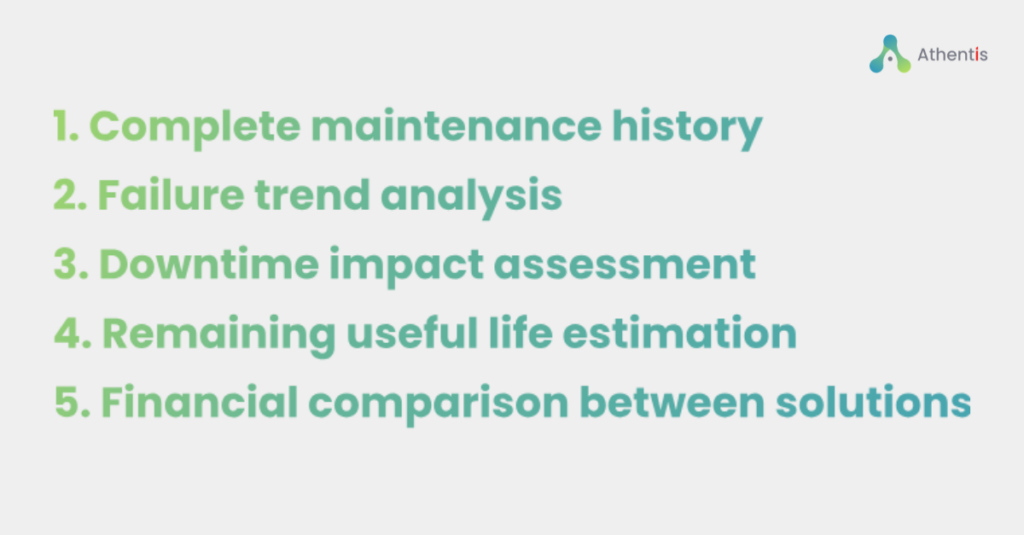
And can it do so without manual reconstruction?
If a regulator or insurer asks for evidence of risk mitigation across critical assets, can that evidence be produced immediately, with traceable approvals and timestamps?
If the answer is uncertain, the asset model may be operationally active but strategically fragile.
The role of Athentis
At Athentis, our focus is not limited to implementing enterprise asset management technology. Our role is to design asset governance models that withstand executive scrutiny.
That means defining criticality correctly.
Aligning asset hierarchies with financial structures.
Configuring workflows that reflect real accountability.
Ensuring lifecycle data informs capital planning.
Integrating asset intelligence with ERP and reporting frameworks.
When implemented with this level of rigor, HxGN EAM becomes more than a maintenance system. It becomes a strategic instrument that connects operational performance with financial and regulatory confidence.
Final thoughts
Most asset strategies do not fail because organizations neglect maintenance. They fail because asset intelligence remains isolated within operations and does not fully inform executive decision-making.
In 2026, that separation carries measurable risk.
Organizations that elevate asset management to a governance discipline gain control over capital allocation, strengthen compliance posture, and build operational resilience. Those that rely on fragmented records and partial visibility will continue to experience avoidable surprises.
The question is no longer whether you have an EAM platform in place.
The question is whether your leadership team can rely on it with confidence.nvironment.

