
Enterprise Asset Management systems have evolved significantly over the past decade. Platforms like HxGN EAM provide organizations with the ability to capture detailed asset histories, automate maintenance workflows, and monitor performance across complex operations.
Most organizations today are not struggling with system capability. They are struggling with consistency.
Two facilities can run the same platform, follow similar processes, and still produce completely different levels of insight. Maintenance may be executed properly in both environments, but the ability to compare performance, identify patterns, or make confident decisions varies significantly.
This difference rarely comes from technology.
It comes from standardization.
The Hidden Cost of Inconsistent Asset Environments
In many organizations, asset management practices evolve locally. Different sites define asset hierarchies in their own way. Failure codes are interpreted differently. Maintenance strategies are adjusted based on local experience rather than shared standards.
At first, this flexibility appears beneficial. Teams adapt quickly to operational realities and maintain a sense of ownership over their processes.
Over time, however, the impact becomes visible.
Data collected across the organization becomes difficult to compare. Performance metrics lose consistency. Reporting requires interpretation rather than direct analysis. What appears to be a unified EAM environment becomes a collection of parallel systems.
This creates several challenges:
- Asset performance cannot be reliably benchmarked across sites
- Maintenance strategies cannot be evaluated at an organizational level
- Failure trends remain localized instead of visible at scale
- Decision-making becomes dependent on individual interpretation
The system continues to function, but its strategic value is limited.
Why Standardization Is Often Avoided
Standardization is widely recognized as important, yet often delayed or only partially implemented.
One reason is the perception that standardization reduces flexibility. Operations teams may feel that strict structures do not reflect the realities of specific sites or asset types.
Another reason is complexity. Aligning asset hierarchies, naming conventions, failure codes, and maintenance strategies across multiple facilities requires coordination, time, and agreement between teams that may operate independently.
There is also a misconception that standardization is a technical task rather than an operational one. In reality, it requires alignment between maintenance, operations, and management, not just system configuration.
Because of this, many organizations accept partial consistency instead of pursuing full alignment.
What True Standardization Actually Means
Standardization in EAM is not about forcing identical processes everywhere. It is about creating a consistent structure that allows data to be interpreted reliably across the organization.
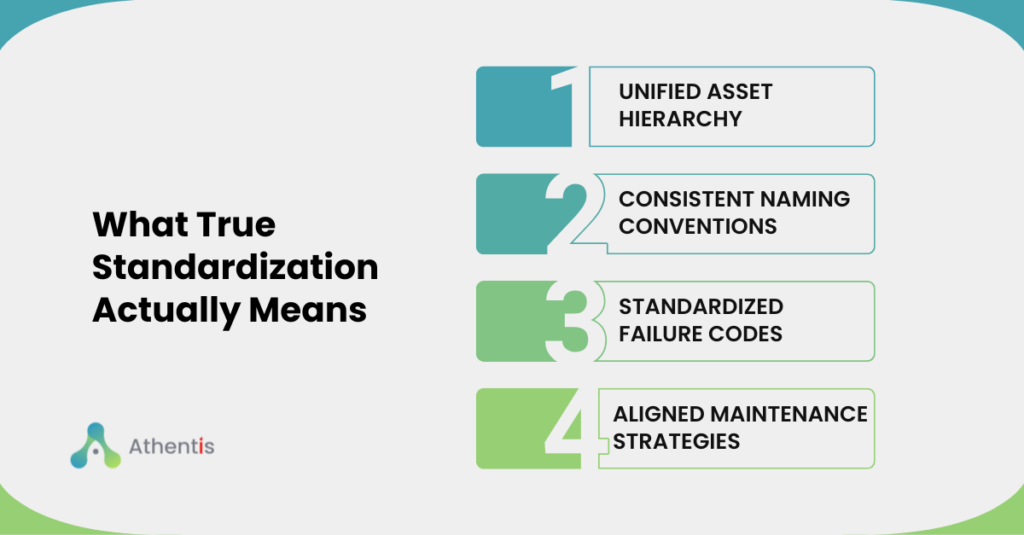
At a practical level, this includes:
- A unified asset hierarchy that reflects how assets are grouped and managed
- Consistent naming conventions so that assets can be identified clearly across locations
- Standardized failure codes that allow issues to be categorized and analyzed at scale
- Aligned maintenance strategies for similar asset types, adjusted where necessary but built on a common framework
This does not eliminate flexibility. It creates a foundation where local adaptations can exist without breaking overall consistency.
From Local Data to Organizational Insight
When standardization is in place, the role of EAM changes significantly.
Data collected at individual sites becomes comparable. Patterns can be identified across facilities rather than within isolated environments. Maintenance strategies can be evaluated based on performance, not assumption.
For example, an organization can begin to answer questions such as:
- Which assets consistently generate the highest maintenance cost across all sites
- Whether similar equipment performs differently under different operating conditions
- Where maintenance intervals are either too aggressive or insufficient
- How failure patterns evolve over time across the entire asset base
These insights are only possible when data is structured in a consistent way.
Without standardization, the same data exists, but it cannot be used effectively.
The Impact on Operational and Strategic Decisions
The benefits of standardization extend beyond reporting.
At an operational level, teams gain clarity. Maintenance activities are defined more clearly, training becomes more effective, and expectations are aligned across locations.
At a management level, decision-making improves. Performance comparisons become meaningful, and improvement initiatives can be prioritized based on evidence rather than assumption.
At a strategic level, the impact becomes even more significant.
Capital planning becomes more informed because asset performance can be evaluated across the entire organization. Risk becomes easier to quantify because failure patterns are visible at scale. Investments in maintenance or replacement can be justified with consistent data.
Standardization does not create these outcomes on its own, but it makes them possible.
The Role of HxGN EAM
Platforms like HxGN EAM are designed to support structured asset environments, but they do not enforce standardization by default.
The system provides the capability to define hierarchies, configure failure codes, and align maintenance strategies. The value comes from how these capabilities are applied.
When implemented with a standardized approach, HxGN EAM becomes a reliable source of asset intelligence. When implemented without it, the system remains operational but limited in its ability to support broader decision-making.
The difference is not in the software. It is in the structure built around it.
The Role of Athentis
At Athentis, standardization is approached as a foundational element of effective asset management.
This involves working with organizations to define asset structures that reflect both operational reality and reporting needs, aligning data models across sites, and ensuring that maintenance and failure data can be interpreted consistently.
The objective is not to remove flexibility, but to create a shared framework that allows the organization to operate as a single system rather than a collection of independent environments.
When this foundation is in place, the full value of EAM systems becomes accessible.
Final Thoughts
Enterprise Asset Management systems are often evaluated based on features and functionality. In practice, their effectiveness depends just as much on how consistently they are used.
Without standardization, data remains fragmented, and insight remains limited.
With standardization, organizations gain the ability to see patterns, compare performance, and make decisions with greater confidence.
The question is not whether your organization has the right tools.
It is whether those tools are producing data that can be trusted and used at every level of the business.

