
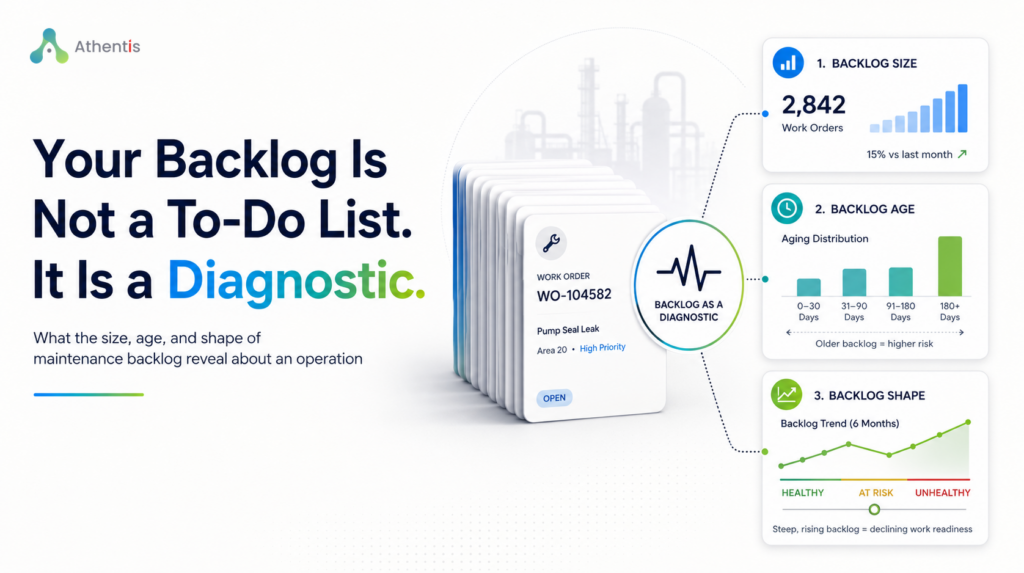
What the size, age, and shape of maintenance backlog reveal about an operation
Every maintenance organization has a backlog. It is almost always viewed as a problem: a list of outstanding work that proves the team is falling behind, a number to be driven down, a source of quiet embarrassment in the monthly review. But a backlog is far more than a queue of pending jobs. Read properly, it is one of the most honest indicators of operational health an organization has, and its size, age, and composition often say more about the state of an operation than the performance reports built to measure it.
The common instinct is to push the backlog toward zero. That instinct is usually wrong, and acting on it can do real damage. A backlog that grows without limit signals a resourcing or reliability problem that needs addressing. But a backlog that is very small, or empty, frequently signals something equally concerning: that work is not being identified, that inspections are not generating the tasks they should, or that the team is operating so reactively it has no forward view of work at all. The goal is not the absence of a backlog. It is a backlog you understand.
Backlog size is a resourcing signal
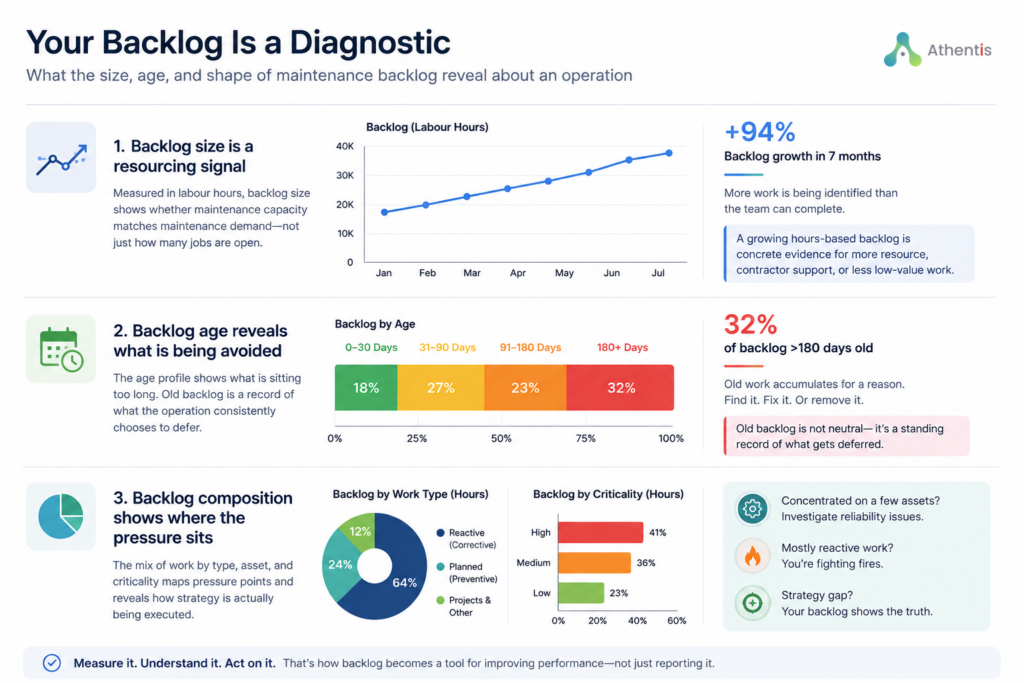
The total volume of outstanding work, measured properly in labour hours rather than a simple count of jobs, indicates whether maintenance capacity matches maintenance demand. A count of open work orders tells you very little, because a hundred small tasks and a hundred major overhauls are not remotely the same load. Measured in hours, the backlog becomes a genuine measure of supply against demand.
A backlog that grows steadily over time is telling you, clearly, that more work is being identified than the team has the capacity to complete. That is not a failure of effort or commitment. It is a structural mismatch between the work the assets require and the resources available to perform it. Read this way, the backlog stops being an embarrassment and becomes an argument. A consistently growing hours-based backlog is concrete evidence for a case that maintenance leaders often struggle to make: that the team needs additional resource, contractor support, or a deliberate reduction in low-value work. Expressed as a trend line, it is far harder to dismiss than a general sense that the team is stretched. Left unspoken, that same growth simply becomes the emergency workload of next quarter.
Backlog age reveals what is being avoided
The age profile of a backlog often matters more than its total size. When jobs sit unaddressed for weeks or months, it is worth asking why, because the answer is rarely random. Very often the oldest items are lower-criticality tasks that never become urgent enough to force their way onto a schedule, accumulating quietly in the background while reactive demands take priority day after day.
That pattern is diagnostic. A backlog weighted heavily toward old, never-scheduled work may indicate that the team is permanently in reactive mode and simply never reaches planned activity. It may indicate that a portion of the aged work is no longer relevant at all, and should be reviewed and closed rather than carried indefinitely as noise that distorts every other measure. It may indicate that criticality is not genuinely driving prioritization, and that work is being selected by urgency and convenience instead. Whichever it is, a backlog full of very old jobs is not a neutral queue waiting to be worked. It is a standing record of what the operation consistently chooses to defer, and the useful question is whether that deferral is a deliberate, risk-based decision or simply the residue of a team that is overwhelmed.
Backlog composition shows where the pressure sits
Breaking the backlog down by work type, by asset, and by criticality turns it from a flat list into a map of the operation. A backlog concentrated on a small handful of assets points directly to specific reliability problems worth investigating, because those assets are generating outstanding work faster than they can be resolved. A backlog dominated by reactive corrective work, with very little planned or preventive activity in the queue, indicates a program that is fighting fires rather than preventing them.
The mix of work sitting in the backlog is a direct reflection of the maintenance strategy as it is actually practiced, rather than as it is described in a document. An organization that believes it runs a proactive, preventive program, but whose backlog is composed almost entirely of reactive breakdown work, is not executing the strategy it thinks it has. The backlog quietly exposes the distance between intention and reality, which is precisely why it is uncomfortable to look at closely, and precisely why it is worth doing.
Why backlog needs structure to be useful
None of this signal is available if the backlog lives as an informal list, a whiteboard, or a scatter of separate spreadsheets. To read a backlog as a diagnostic, the work has to be captured consistently, categorized by type and criticality, estimated in labour hours, and dated so its age can be tracked. Without that structure, the backlog is just a pile of jobs, and the questions that actually matter cannot be asked of it, because the data needed to answer them was never recorded in a comparable way.
This is where the maintenance system earns its place. In Octave Attune, outstanding work carries the attributes that make backlog analysis possible: work type, the associated asset, criticality, estimated hours, and the date it was raised. Because that data is captured consistently across every job and every site, the backlog can be measured in hours rather than counted, trended over time rather than viewed as a single snapshot, and broken down by asset, type, or criticality rather than treated as one undifferentiated mass. The backlog becomes something the organization can interrogate, instead of something it simply works through and hopes to shrink.
Managing the signal, not just the queue
The objective is not an empty backlog. It is a controlled one: sized to a healthy forward view of work, aged appropriately, and weighted toward planned and preventive activity rather than reactive repair. A backlog managed to that standard becomes a planning instrument rather than a scorecard of failure. It shows where resources are genuinely short, which assets are consuming a disproportionate share of effort, and whether the balance between reactive and proactive work is moving in the right direction over time.
A backlog is going to exist regardless of how good the operation is. Even the best-run maintenance functions carry one, by design, because a healthy backlog of prepared work is what allows scheduling to be efficient. The real difference between operations is not whether they have a backlog, but whether they treat it as a source of guilt to be cleared or a source of information to be read. The organizations that manage maintenance well have learned to do the second. They watch the backlog closely not because they are behind, but because it tells them, earlier and more honestly than almost any other measure available, where the operation is actually heading.

