

Why stock accuracy, condition and reservation decide whether maintenance can actually start
The maintenance planner checks the inventory record before placing a job on the schedule. The required part shows a positive balance, so the work is treated as ready. When the technician arrives, the bin is empty. Or the part is there but already reserved for another job. It may be awaiting repair, stored at a different site, damaged, obsolete, or incompatible with the equipment revision in front of them.
The system was not necessarily wrong in a simple numerical sense because a quantity existed somewhere. The problem is that quantity on hand was mistaken for maintenance availability.
For a maintenance team, a spare part is available only when the correct item, in the correct condition, can be issued to the correct job at the required time. Anything less is inventory that may satisfy an accounting report while still leaving the asset out of service.
Stock on hand is not the same as usable stock
Most inventory screens are built around a number: how many units are currently recorded in the store. That number is necessary, yet it does not describe whether the stock can support a specific maintenance task. Some units may be reserved against planned work. Others may be in transit between sites, held for inspection, awaiting repair, quarantined after a quality concern, or assigned to a critical asset that cannot release them.
Condition matters as much as quantity. A repairable motor in the store may still require testing. A valve may have the correct general description but the wrong pressure rating or connection. A control component may have been superseded by a newer revision that needs a different configuration. Two parts may look interchangeable until the technician reaches the asset and discovers the detail that prevents installation.
This is why a reliable materials process has to answer a maintenance question, not only a stock question. It must show whether the item can be committed to this job, at this location, for this equipment, without creating a new risk elsewhere.
How the system and the shelf drift apart
Inventory inaccuracy rarely begins with one large mistake. It grows through hundreds of small transactions that are delayed, skipped or recorded differently. A technician takes a part during an urgent callout and plans to issue it later. An unused item is returned to the nearest shelf rather than the correct bin. A storekeeper receives a delivery under a duplicate part number. A repairable core is sent away without its status being updated. A component is borrowed by another site and the transfer remains in an email.
Each event is understandable in isolation, especially during a busy shift. Together, they create a store where the digital balance and the physical reality slowly separate. The difference may remain hidden until a high-priority job depends on the missing item.
Duplicate descriptions add another layer of confusion. The same component may appear under a manufacturer number, a local nickname and a legacy code from an older system. Conversely, one broad description may cover several items that are not technically equivalent. When the catalogue is unclear, every transaction becomes harder to record accurately and every search takes longer.
The real cost is paid outside the storeroom
A missing or unusable spare rarely appears as a major inventory event. The financial effect is usually recorded elsewhere. A technician waits while someone searches another bin. A planned shutdown window is extended. An emergency purchase is raised at a premium price. A courier is sent across the country. Production cannibalises a working asset to obtain a component, creating another incomplete machine that must be restored later.
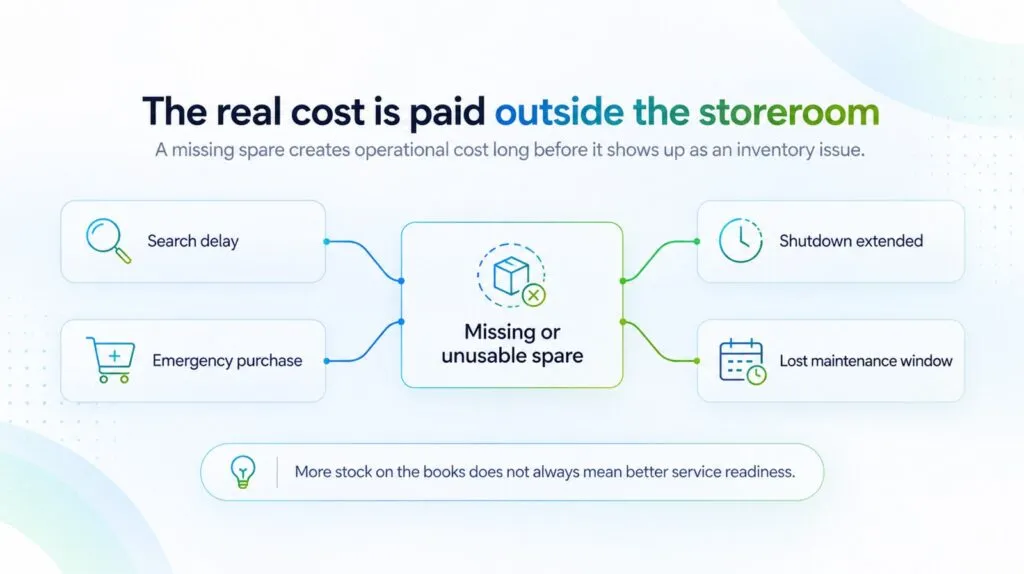
The organisation may also buy a second part even though one is technically still on the books. Inventory value rises while service readiness remains unchanged, leaving finance with more stock on the balance sheet and maintenance with the same shortage at the asset.
The most damaging cost can be the loss of a planned opportunity. When a job cannot proceed during an agreed maintenance window, the work returns to the backlog and may wait weeks for another isolation or production stop. The part itself may be inexpensive, while the lost window can carry a far greater operational cost.
Critical spares need different rules
Traditional inventory analysis often focuses on purchase value and usage. Those measures are useful for controlling working capital, but they do not fully describe maintenance consequence. A low-cost seal, fuse or sensor can stop an entire line if it has a long lead time or no practical substitute. An expensive assembly may carry lower immediate risk if the operation has redundancy or a fast repair agreement.
Critical spare policy should therefore consider the asset it protects, the consequence of failure, supplier lead time, demand uncertainty, repairability, shelf life and the availability of substitutes. Historical usage alone can be misleading because the most important spare may be one that has never been consumed. Its purpose is to protect the organisation from a rare event with a severe consequence.
This does not mean filling the store with every possible item. It means making stocking decisions deliberately. Some parts should be held locally. Some can be shared across sites. Some need a framework agreement, repair exchange or guaranteed supplier response. The correct strategy depends on the time the operation can tolerate without the asset.
Reservation and kitting turn stock into job readiness
A job is not ready because the required parts appear somewhere in inventory. It becomes ready when those parts have been identified, reserved and, where appropriate, assembled into a kit for that work order. Reservation protects planned work from an unrelated withdrawal. Kitting confirms that the full material requirement is present before the maintenance window begins.
This is especially important for shutdown work, where one missing gasket, fastener or consumable can hold up a much larger task. The main component often receives the most attention, while the small supporting items are assumed. A complete kit makes those assumptions visible early enough to correct them.
The process must also work in reverse. When a job is cancelled or rescheduled, reserved stock should be released. When a kit returns with unused material, each item should be put back into the correct condition and location. Otherwise, reservation improves one schedule while quietly making the inventory record less reliable for the next.
Repairable spares are a circulation system
Motors, gearboxes, pumps, drives and valves often move through a cycle of service, removal, repair, inspection and return. Treating them like ordinary consumable stock creates a misleading picture. A unit awaiting repair is physically present, yet it is not ready for issue. A repaired unit may require certification or testing before it can be trusted. A removed core may carry warranty value that is lost if it is not returned correctly.
Repairable spares need clear status, location, condition and identity throughout that cycle. Serial or asset tracking may be required so the organisation can see where the unit has been used, what failed, what work was performed and whether the same item is returning repeatedly with a similar problem.
When this circulation is visible, the store can support maintenance with fewer surprises. It also provides evidence for repair-versus-replace decisions, supplier performance reviews and warranty recovery. Without it, the inventory balance can include several units that are present in name and unavailable in practice.
One view across sites can prevent an unnecessary purchase
Multi-site organisations often have more spare capacity than any individual store can see. One facility may be waiting for a supplier while an equivalent component sits unused at another location. Shared visibility allows the organisation to transfer a part, protect a maintenance window and avoid an emergency order.
That opportunity depends on consistent part records and trusted stock information. Sites need to describe equivalent items in the same way, maintain accurate locations and record transfers promptly. A central view built on inconsistent local data only spreads uncertainty across a larger area.
The connection between EAM and ERP also matters. Maintenance demand begins with the asset and the work order. Purchasing and financial control often sit in the ERP environment. Requisitions, purchase orders, receipts, reservations and actual consumption have to move between those processes without losing the link to the job that created the demand. When the handover is unclear, procurement may complete its transaction while maintenance still has no usable part.
What Octave Attune EAM should make possible
Octave Attune EAM supports the materials activities that connect stock to maintenance work, including requisitions, purchasing, receipts, issues and returns, reservations, pick tickets, physical inventory, stock level control and repairable spares. Work orders can carry material requirements, while actual consumption remains connected to the asset and maintenance history. Mobile transactions help teams update the record where the movement happens rather than relying on later reconstruction.
The system can also support different replenishment and counting approaches, visibility across stores, substitute parts and analysis of usage and demand. These functions are valuable only when the underlying catalogue, responsibilities and transaction rules are clear. Technology cannot make a spare available if users do not trust the part record or if urgent withdrawals routinely bypass the process.
Athentis helps organisations structure this connection between maintenance, stores and procurement. The work includes cleaning part records, defining critical spare logic, aligning reservations and kitting with planning, and configuring the EAM and ERP handover so each transaction keeps its operational meaning. The goal is a materials process that supports execution, not simply a more detailed stock report.
Inventory should answer whether the work can start
A healthy maintenance store is not necessarily the one with the highest stock value or the lowest number of items. It is the one that can provide the right material when the operation needs it, while keeping working capital under control. That balance requires accurate quantities, clear condition, reliable location, sensible criticality and disciplined movement of parts.
The practical test is whether a planner who sees the required part in the system can commit it to the job with confidence. Can it be found, issued and installed without discovering a hidden reservation, condition problem or catalogue error? If the answer is uncertain, the job is not fully prepared, regardless of what the balance says.
A spare part record should do more than prove that something was purchased. It should help maintenance know whether the work can begin. When it does, inventory becomes part of reliability. When it does not, the asset waits while the organisation searches for stock it believed it already had.

