
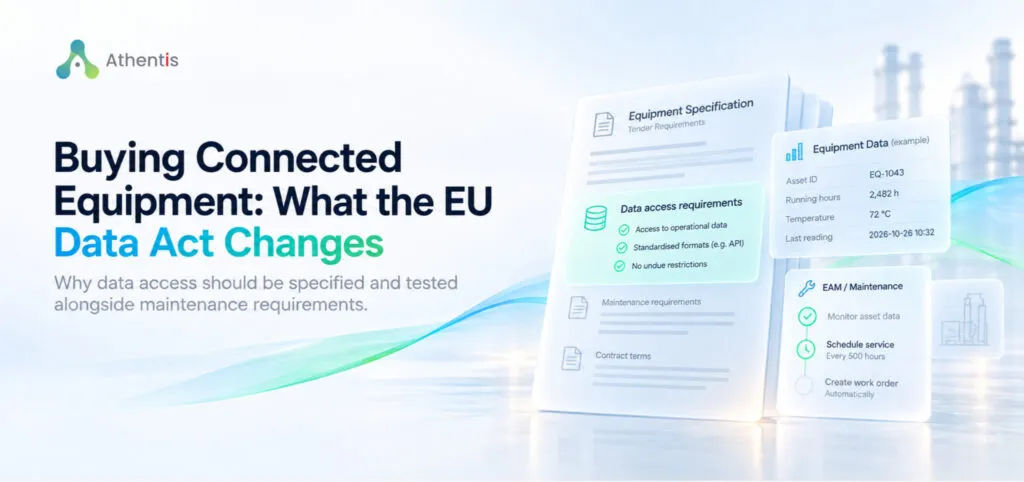
Why data access should be specified and tested alongside the equipment’s maintenance requirements.
Consider a food manufacturer evaluating a connected compressor. The supplier demonstrates a portal showing running hours and temperatures, while the maintenance team wants to know how those readings will reach its EAM system and support the service schedule.
That is a question to resolve during equipment selection, when the cost and responsibility for the connection can still be included in the purchase.
What the EU Data Act changed in September
The EU Data Act has applied since 12 September 2025, giving users of covered connected products rights to access data and share it with eligible third parties, including maintenance providers. An additional design obligation applies to covered products and related services first placed on the EU market after 12 September 2026. It requires access to be built into the design, including direct access where relevant and technically feasible.
The access rules cover relevant raw and pre-processed data that are readily available to the data holder, together with the information needed to interpret them. A supplier’s inferred analysis, such as a proprietary failure prediction, generally falls outside that obligation. Data protection and trade-secret safeguards still apply. Applicability and exemptions need to be checked for the equipment and its manufacturer or related-service provider.
Define the maintenance use before specifying the connection
Our recommendation is to begin with one maintenance task the data should support. For the compressor, that could mean using verified running hours to determine when a service falls due. This gives procurement and maintenance a concrete requirement to discuss with the supplier and integration team.
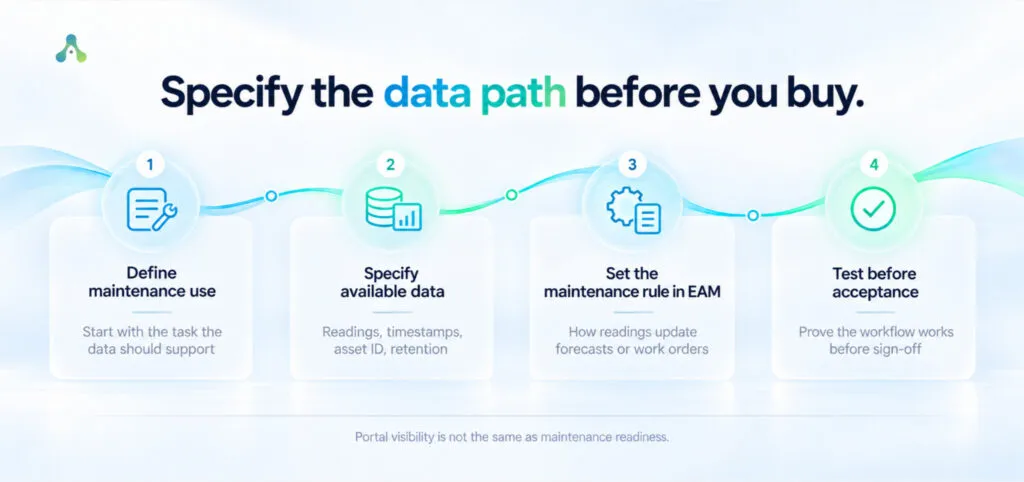
Three areas need to be documented:
- Available readings. Request a sample dataset with field definitions, including units and timestamps. Establish how each reading identifies the equipment it belongs to. Confirm which historical readings will be available and how long they will be retained.
- Access and ongoing support. Confirm the interface or export method. Agree who will maintain the connection after commissioning, including how changes to the supplier’s software will be handled.
- Commercial arrangements. Separate data access from optional monitoring or analytics services. Identify the work required to connect the data to EAM, with an agreed scope and price.
User access to covered data is free of charge. Making data available to a third-party recipient may involve reasonable compensation under the Act. These arrangements should be distinguished from the cost of designing and maintaining the integration.
Specify how the readings affect maintenance
For the compressor, specify how EAM will calculate the hours accumulated since the last completed service. Record the starting reading and agree how the equipment’s cumulative meter will be linked to the maintenance history. Define whether new readings should update a service forecast or generate a work order, including what happens when that work is already open.
A controller replacement or meter reset should have a defined handling procedure that preserves the record of accumulated use. Agree how an unexpected decrease in the meter value will be flagged for review. Set the update frequency according to how much notice the maintenance team needs to prepare the work.
The service interval should follow the applicable manufacturer guidance and the site’s approved maintenance strategy. The integration specification should state how that rule will be applied to the incoming data.
Include the data connection in acceptance testing
Ask the equipment supplier and integration team to demonstrate the agreed workflow before final acceptance. Use sample readings to show that the correct asset receives the update and the maintenance rule behaves as specified. Have the team also show how a failed connection or stale reading becomes visible to the person responsible.
Record those checks in the project’s acceptance criteria. Two machines with similar monitoring features may require different work to support the same maintenance task, so that work belongs in the comparison of supplier proposals.
Octave’s published case study of Alvest Equipment Services illustrates this application. AES describes using Databridge Pro to collect equipment operating time and automatically generate maintenance schedules in its Attune EAM environment.
At Athentis, we support EAM implementation and integration for organisations in Greece and Cyprus. If you are evaluating connected equipment, we can review the supplier’s data specification against your maintenance requirements before the technical scope is agreed.

