
For years, asset inventory was treated as a maintenance requirement.
Organizations needed to know what equipment they owned, where it was located, when it was last serviced, and which spare parts it required. In that context, the asset register was primarily an operational tool. It supported maintenance planning, compliance checks, inspections, and lifecycle management.
That view is no longer enough.
As industrial operations become more connected, asset inventory is beginning to serve a wider purpose. It is no longer only a record of physical equipment. It is becoming a foundation for operational resilience, audit readiness, risk management, and long-term asset control.
For asset-intensive organizations, this shift matters.
Production lines, warehouse systems, refrigeration units, building systems, rental equipment, sensors, PLCs, and monitored field assets are increasingly connected to digital infrastructure. Equipment that was once treated as purely mechanical now often includes software, remote monitoring, data interfaces, or communication with other systems.
This creates a practical challenge.
If an organization does not have a reliable view of its connected operational assets, it cannot fully understand its operational exposure.
Asset Inventory Is No Longer Just a List of Equipment
A traditional asset register answers important questions:
- What assets do we own?
- Where are they located?
- Who maintains them?
- What is their service history?
- Which spare parts do they require?
These questions still matter. They remain central to effective Enterprise Asset Management.
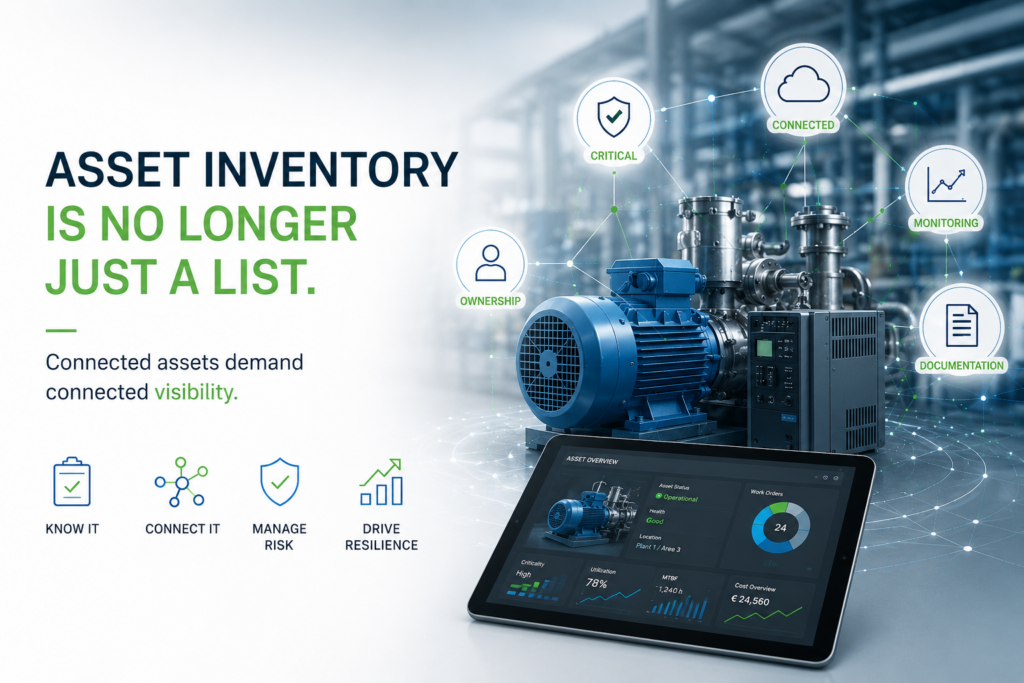
However, modern operations require additional context. Organizations increasingly need to understand whether an asset is connected, which systems it communicates with, whether it supports a critical process, and who owns responsibility for its configuration, maintenance, and operational performance.
This is where the definition of asset inventory expands.
A strong asset inventory should help the organization understand not only what assets exist, but how those assets behave, interact, and affect continuity.
Without that level of visibility, operational risk becomes difficult to measure.
Why This Has Become More Urgent in 2026
The pressure around connected assets has increased significantly.
Regulatory expectations are becoming more demanding. The EU’s NIS2 Directive establishes a cybersecurity framework across 18 critical sectors and introduces stronger expectations around risk management, reporting, supervision, and enforcement. It also brings top management accountability into focus for non-compliance with cybersecurity risk management measures.
This matters because many asset-intensive organizations operate in environments where IT and operational technology are no longer separate in practice.
A facility may have connected production equipment, monitored energy systems, remote diagnostics, warehouse automation, and service assets reporting data back into operational platforms. Each connection creates value. Each connection also increases the importance of knowing exactly what exists, where it sits, and how critical it is.
This is not only an IT concern.
For manufacturing, food and beverage, distribution, and equipment service operations, connected assets directly affect uptime, safety, quality, and service delivery. If the inventory is incomplete or inconsistent, decisions become weaker across maintenance, compliance, and risk management.
Where the Asset Inventory Gap Usually Appears
The asset inventory gap rarely appears as one obvious failure. It usually develops gradually.
A site adds condition monitoring to critical equipment. A service team introduces remote diagnostics. A warehouse upgrades automated handling systems. A facility team connects HVAC or refrigeration systems for energy monitoring. Each step is useful on its own.
Over time, however, the organization can lose a unified view of what is connected and how those assets support daily operations.
Common weaknesses include:
- Asset records that describe equipment mechanically, but not digitally
- Inconsistent naming between maintenance, IT, and operations systems
- Missing information about sensors, controllers, interfaces, or remote access
- Unclear ownership between operations, maintenance, and IT teams
- Limited visibility into which connected assets support critical processes
None of these issues mean the organization is poorly managed. They are common consequences of increasing operational complexity.
But if they are not addressed, they weaken decision-making.
Why EAM Has a Central Role to Play
Enterprise Asset Management platforms such as HxGN EAM are well positioned to support this wider view of asset inventory because EAM already sits close to operational reality.
It contains asset structures, maintenance histories, inspections, work orders, failure records, spare parts relationships, and lifecycle information. These are not abstract records. They reflect how equipment is actually used, maintained, and relied upon.
When asset inventory is strengthened within EAM, organizations gain a more reliable operational foundation.
They can connect asset criticality with maintenance history. They can identify which equipment supports essential processes. They can understand where connected assets require stronger ownership and governance. They can align operational risk with asset condition and maintenance planning.
This does not turn EAM into a cybersecurity platform.
It makes EAM a stronger source of operational truth.
That distinction is important.
What a Modern Asset Inventory Should Include
A mature asset inventory should still begin with the fundamentals: location, hierarchy, condition, maintenance history, spare parts, and inspection records.
For connected operations, additional context becomes increasingly important:
- Whether the asset is connected or standalone
- Which systems or platforms the asset communicates with
- Whether the asset supports critical operations
- Who owns maintenance, configuration, and operational responsibility
- Whether remote monitoring or remote access exists
- What documentation is available for inspections, interventions, and changes
The goal is not to overload the asset register with unnecessary detail.
The goal is to make the inventory useful for real decisions.
A modern asset inventory should support maintenance planning, operational risk assessment, audit readiness, and continuity planning at the same time.
From Static Register to Operational Resilience
The real value appears when asset inventory stops being treated as a static list and becomes part of how the organization manages resilience.
With a stronger inventory, maintenance teams can prioritize assets based on both condition and operational importance. Operations teams can understand dependencies more clearly. Management can see where risk is concentrated. Compliance teams can produce more reliable documentation when needed.
This creates practical benefits:
- Faster response when critical assets require intervention
- Clearer ownership of connected equipment
- Better prioritization of inspection and maintenance work
- Stronger evidence for compliance and risk reviews
- Improved coordination between operations, maintenance, and IT
The inventory becomes more than a record.
It becomes a working model of operational exposure.
Why This Matters Across Athentis’ Core Industries
For manufacturing, connected production equipment creates efficiency but also increases dependency on accurate asset visibility. If asset records do not reflect the real operating environment, maintenance and risk decisions become less reliable.
For food and beverage, traceability, uptime, hygiene, temperature control, and equipment reliability are closely linked. A stronger asset inventory supports both compliance and production continuity.
For distribution, automated systems, conveyors, warehouse equipment, and logistics infrastructure depend on coordinated maintenance and clear ownership. Missing asset context can quickly affect throughput.
For equipment service and rental, connected assets create opportunities for remote monitoring, more accurate service planning, and better lifecycle control. They also require stronger visibility into location, usage, condition, and responsibility.
Across all of these sectors, the direction is clear.
Assets are becoming more connected, and asset inventory must become more intelligent.
The Role of Athentis
Athentis supports organizations in strengthening the foundations of Enterprise Asset Management so that asset data can support confident operational decisions.
In the context of modern asset inventory, this means helping organizations structure asset hierarchies, improve data consistency, define ownership, and align asset records with operational reality.
The objective is not to create more documentation.
It is to ensure that asset information is accurate, usable, and connected to the decisions that matter.
When implemented correctly, HxGN EAM can help organizations move from fragmented asset records to a reliable operational source of truth.
Final Thoughts
The asset inventory has become one of the most important foundations of modern asset management.
It is no longer enough to know what equipment exists. Organizations also need to understand how assets are connected, how critical they are, who owns them, and how they affect operational continuity.
In 2026, this is becoming essential.
As regulatory expectations increase and operations become more digitally connected, asset-intensive organizations need a stronger bridge between physical equipment, operational risk, and digital resilience.
That bridge starts with the asset inventory.
The question is no longer whether your assets are recorded.
It is whether your asset inventory reflects the reality your organization depends on every day.

