
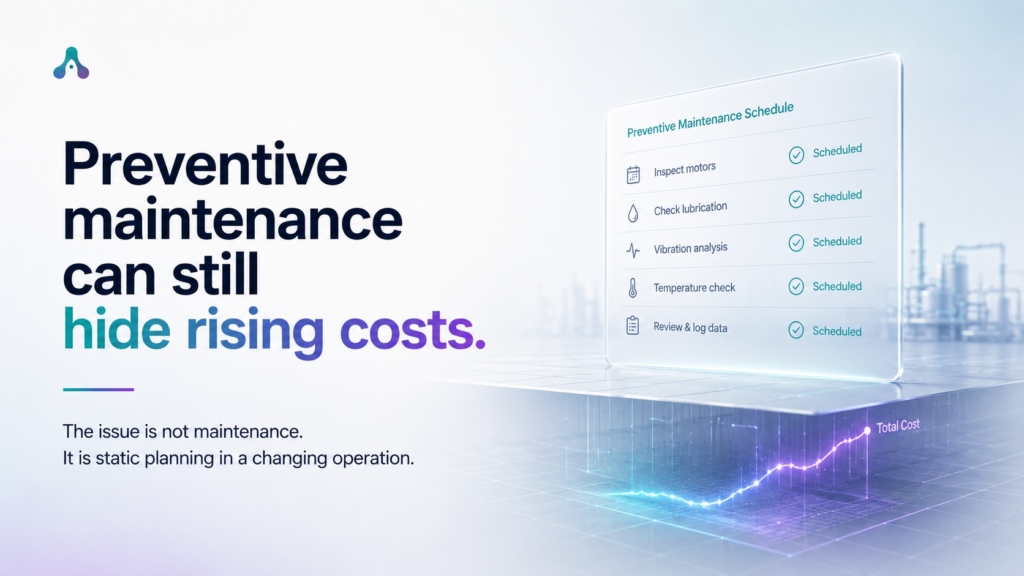
And How to Fix It Without Increasing Risk
Preventive maintenance has long been seen as a marker of operational maturity.
If assets are serviced regularly, inspected on schedule, and maintained according to predefined intervals, the expectation is clear: reliability improves and risk is reduced. For many organizations, this shift away from reactive maintenance has delivered real value.
On the surface, the model works.
Assets are maintained. Failures are reduced. Compliance requirements are met.
However, over time, a different pattern often begins to emerge.
Maintenance workloads continue to grow. Costs increase year after year. Downtime does not disappear, it simply becomes more structured and less visible.
Despite doing more maintenance, organizations do not always see proportional improvements in performance.
This is where the problem becomes difficult to detect.
The issue is not preventive maintenance itself.
The issue is that it often remains static in environments that are constantly changing.
When “Best Practice” Becomes Inefficient
Preventive maintenance strategies are typically built around fixed schedules. Assets are serviced based on time intervals, usage thresholds, or manufacturer recommendations. These frameworks are often established during implementation and then carried forward with minimal adjustment.
Initially, this creates consistency and control.
Over time, however, the operating environment evolves.
Production volumes shift. Equipment ages. Usage patterns change. Some assets become more critical, while others become less relevant. Despite these changes, maintenance strategies often remain unchanged.
The result is a gradual misalignment between effort and value.
- Maintenance tasks are performed too frequently on stable assets
- Resources are consumed by low-risk equipment
- Maintenance plans expand without clear impact on performance
- Technicians spend more time executing tasks than evaluating asset condition
The system continues to function, but efficiency begins to decline.
The Hidden Cost of Over-Maintenance
Over-maintenance is rarely identified as a problem because it does not create immediate failure.
In fact, it often looks like success.
High completion rates, structured schedules, and consistent activity create the impression of control. From a reporting perspective, everything appears to be working as intended.
The financial impact, however, tells a different story.
- Labor is consumed by tasks that do not improve reliability
- Assets are taken offline for maintenance that is not required
- Components are replaced before their useful life is fully realized
- Operational flexibility is reduced due to excessive planned work
At the same time, critical issues can still be missed because maintenance is driven by schedule rather than condition.
This creates a difficult paradox.
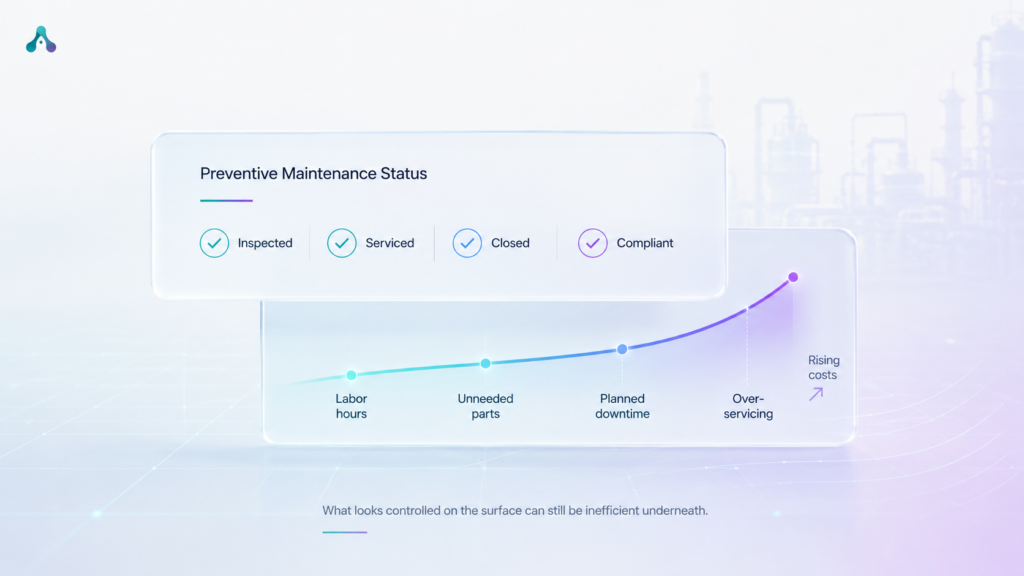
More maintenance activity does not necessarily lead to better outcomes.
In many cases, it simply leads to higher cost.
Why This Happens in EAM Environments
Enterprise Asset Management platforms such as HxGN EAM are designed to support structured maintenance processes. They provide the ability to define preventive schedules, automate work orders, and track execution at scale.
The system performs exactly as configured.
The challenge lies in how those configurations evolve over time.
Preventive maintenance strategies are often treated as fixed rules rather than dynamic models. Once implemented, they are rarely revisited with the same level of attention.
Several patterns contribute to this:
- Maintenance schedules are inherited and never reassessed
- Changes are avoided to reduce perceived operational risk
- Data collected within the system is underutilized
- Ownership of optimization is unclear across teams
As a result, the system continues to generate work, but not necessarily value.
The Shift Toward Condition-Based Thinking
Organizations that begin to address this issue do not abandon preventive maintenance. They refine it.
The focus shifts from maintaining everything on schedule to maintaining assets based on actual need.
This requires a different way of thinking.
Instead of asking how often an asset should be serviced, organizations begin to ask:
- How does this asset behave over time?
- What are the early indicators of degradation?
- Which interventions actually reduce failure risk?
- Where can maintenance intervals be safely extended?
This transition depends on the ability to interpret the data already available within the system.
Maintenance history, failure patterns, and performance trends begin to guide decisions, rather than predefined intervals alone.
What Changes in Practice
When preventive maintenance is actively optimized, the impact becomes visible across operations.
Maintenance volume decreases, but effectiveness increases.
Technicians spend more time on meaningful interventions rather than repetitive tasks.
Downtime becomes more predictable because it is aligned with real conditions.
Costs stabilize as unnecessary work is eliminated.
Most importantly, maintenance becomes aligned with actual risk.
High-impact assets receive the attention they require.
Stable assets are no longer over-serviced.
This creates a more balanced and efficient operating model.
The Role of HxGN EAM
HxGN EAM provides the foundation required to support this transition.
The system captures maintenance history, tracks asset performance, and allows organizations to adjust strategies over time. It enables the move from fixed schedules toward more informed, data-driven maintenance models.
The value of the platform increases when it is used not only to execute maintenance, but to evaluate it.
- Work orders become a source of insight
- Failure data becomes a guide for strategy
- Asset history becomes the basis for continuous improvement
When these elements are actively used, preventive maintenance evolves into a dynamic and adaptive process.
The Role of Athentis
Athentis supports organizations in moving beyond standard maintenance configurations toward optimized maintenance strategies.
This involves reviewing existing preventive maintenance programs, identifying areas of over-maintenance, and aligning maintenance activity with real asset behavior and risk.
The objective is not simply to reduce maintenance activity.
It is to ensure that every intervention contributes to performance, reliability, and cost control.
By combining system capability with structured analysis, organizations gain clarity on where effort is required and where it is not.
Final Thoughts
Preventive maintenance remains a fundamental part of asset management.
However, when it is treated as a fixed structure rather than a continuously evolving strategy, it can quietly become a source of inefficiency.
The organizations that perform best are not those that do the most maintenance.
They are the ones that apply maintenance with precision.
The right action.
At the right time.
On the right asset.
The question is not whether your preventive maintenance program is active.
It is whether it still reflects how your assets actually perform today.

