

Why heat-related failures often arrive weeks or months after the heatwave, and what maintenance teams in Greece and Cyprus should review before winter
By October, most maintenance teams in Greece and Cyprus have stopped talking about the summer.
It was not an easy one. In late July, temperatures reached around 43°C in parts of central Greece, and the Ministry of Labour restricted outdoor manual work during the hottest hours in the worst-affected areas. A prolonged heatwave in late August kept much of the mainland in the high 30s, with red-code wildfire warnings in several regions. In Cyprus, electricity demand broke records. Days before the peak, the transmission system operator said the grid could meet demand as long as no generating units broke down. On the evening of 22 July, with faults at two units and demand at record levels, rolling power cuts moved across the island.
Power stations are among the most carefully maintained assets in any country, so the lesson here has nothing to do with blame. Heat squeezes the margin for everyone. It pushes equipment harder at exactly the moment when a failure matters most.
Through all of it, most industrial sites kept going. Lines ran. Cold rooms held their temperature. Trucks made their deliveries. And so the summer gets filed away as a difficult season that the team got through.
That conclusion is understandable, but it misses something important. Getting through the heat without a failure is not the same as getting through it without damage. Heat rarely breaks equipment immediately. It ages it. And the failures it causes tend to arrive later, when nobody is connecting them to the summer anymore.
What Heat Actually Does to Equipment
Most of the processes that wear out industrial equipment are chemical, and chemistry speeds up as temperature rises. Reliability engineers work with a simple rule of thumb based on this: for many ageing processes, every 10°C increase roughly doubles the rate of ageing.
The examples will be familiar to anyone who has spent time in a plant. The insulation in a motor winding loses about half of its expected life for every 10°C it runs above its rated temperature. Lubricating oil oxidizes about twice as fast for every 10°C rise, which shortens its useful life in gearboxes, hydraulic systems and compressors. The electrolytic capacitors inside variable speed drives and power supplies age in the same way.
Lead-acid batteries, the type found in most UPS systems and much standby equipment, are even more sensitive. A widely used industry guideline says their expected life falls by half for every 8°C above 25°C. A battery that should last four years at 25°C will last about two years at 33°C, and the batteries inside a UPS always run warmer than the room around them.
None of this raises an alarm. Nothing trips, and no work order is created. The asset simply uses up months, sometimes years, of its life in a single season, and keeps working as if nothing happened.
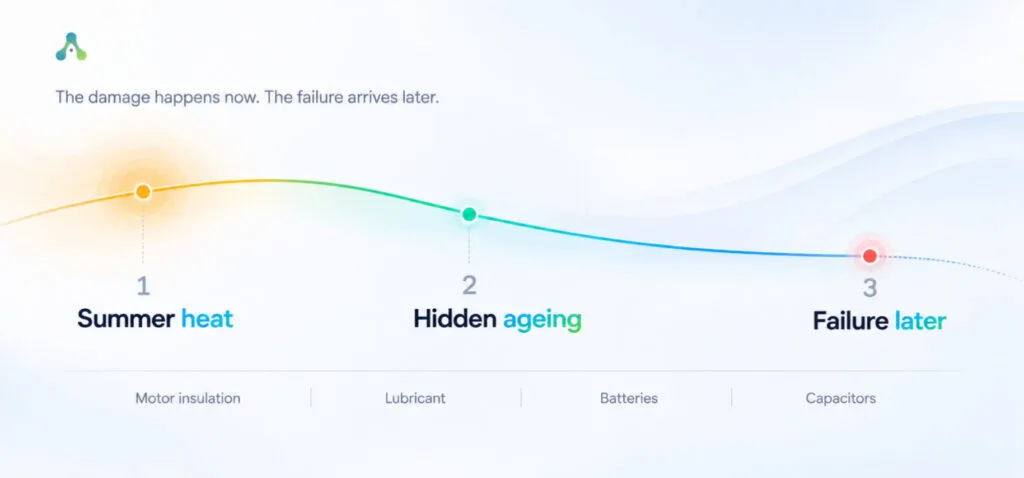
The failure comes later, usually under a different kind of stress. Batteries are the clearest example. Heat damage to a battery cannot be reversed, and cold weather reduces the capacity a battery can deliver. A battery weakened in August can cope perfectly well this month and then fail on the first cold morning in January. The same pattern appears across a site: a motor with aged insulation that fails when it restarts after a power cut, a gearbox with degraded oil that gives up during the year-end production peak, a drive that trips in the first hot week of next June. When those failures happen, very few people will link them to this summer. They will be recorded as bad luck, an old asset, or a supplier problem.
This is why the next few weeks matter. The damage has already been done, but most of the failures have not happened yet. Between now and the first cold snap, maintenance teams have the chance to find them first.
The Maintenance Plan Did Not Notice the Heat
Most preventive maintenance is scheduled by the calendar. A six-month service happens every six months, whether the summer was mild or the thermometer spent days above 40°C. The plan has no idea what the assets went through.
That matters, because equipment ratings and service intervals are built around reference conditions. Under IEC 60034-1, the international standard for rotating electrical machines, the rated output of a standard motor assumes cooling air no hotter than 40°C. This summer, outdoor temperatures in parts of Greece went above that. And the places where equipment actually sits are usually hotter than the weather report: electrical rooms with poor ventilation, compressor houses, rooftop plant, warehouse roof spaces, production areas next to ovens and dryers.
Many equipment manuals already account for this. They include a second, shorter maintenance schedule for severe or harsh operating conditions, and high ambient temperature and dust are often on the list. In practice, the standard schedule is usually the one loaded into the maintenance system, and it stays there for years.
Running hours tell a similar story. A chiller, air compressor or refrigeration unit that normally runs for part of the day may have run almost without stopping for weeks. If its maintenance is triggered by running hours, and the meter readings are actually being recorded, the plan adjusts by itself. If it is triggered by the calendar, the extra wear is invisible to the system.
In many organizations, the only part of the maintenance function that adjusts for the weather is an experienced engineer: the person who knows that a particular compressor runs a few degrees hotter on humid days. That knowledge is valuable. It also belongs in the maintenance plan, where it does not depend on one person remembering it.
Where This Summer Is Hiding
Every asset-intensive operation carries some of this summer forward. Where it hides depends on the business.
In manufacturing, the first place to look is usually the electrical infrastructure. Variable speed drives depend on cooling fans and clean filters, and both suffer in hot, dusty conditions. Electrical connections expand and contract with every hot day and cooler night, and that repeated thermal cycling can loosen them over time. Hydraulic systems run hotter, so the oil thins and oxidizes and the seals harden. Compressed air systems work harder, and air dryers struggle with the extra moisture that humid coastal air brings in.
In food and beverage, the pressure falls on refrigeration. A condenser that has to reject heat into 40°C air runs at higher pressure and for longer, so compressors build up running hours and stress much faster than in a normal month. Door seals, evaporator fans and defrost systems all work harder when doors open into hot, humid air. Temperature records kept for food safety are worth reading as maintenance data, too. An excursion that was corrected in July may be an early sign of a system that is close to its limit.
In distribution and fleet operations, heat affects forklift batteries and charging areas, dock equipment and conveyors in hot warehouses, and every part of a vehicle that depends on rubber, coolant or battery chemistry. Tyres age faster in heat. Engine cooling systems and transport refrigeration units have spent much of the summer working near their limits.
In facilities and building services, HVAC is the obvious concern, but it is not the only one. Lift machine rooms, UPS batteries and standby generators often sit in spaces that get very hot. Where the July power cuts in Cyprus reached a site, standby equipment that normally runs only for short tests had to carry real load in the hottest week of the year. That alone justifies a proper inspection.
A Post-Summer Review That Is Worth the Time
A useful post-summer review is a focused exercise rather than a large project, and it should end with real changes to the plan. Five steps cover most of it.
Read the summer in your work order history. Compare corrective work orders from June, July and August with the same months last year, and with the spring. Look for where reactive work increased: which asset classes, which sites, which locations. Look at the failure and cause codes on those jobs. If the codes cannot tell you whether heat played a part, that is a finding in itself, and exactly the kind of gap that consistent failure coding is meant to close. Then check which preventive jobs slipped. In many organizations in Greece and Cyprus, August brings the hottest weeks and the main holiday period together, and on the worst days heat measures can limit outdoor work. Preventive work is usually the first thing to move.
Check the meters, not only the calendar. Confirm that running-hour and cycle readings were actually recorded through the summer, especially for compressors, chillers, generators and refrigeration plant. For heat-sensitive assets that are still on calendar schedules, and that clearly worked harder than usual, bring the next service forward instead of waiting for the date.
Start where criticality meets exposure. Not every asset needs attention this month, and trying to inspect everything usually means inspecting nothing properly. Begin where high criticality meets high heat exposure: critical assets in hot rooms, on roofs, outdoors, or running close to continuously. That overlap is your October list, and asset criticality is what keeps it short enough to finish.
Look for damage that has not failed yet. The most valuable checks are the ones designed to find problems before they stop anything: a thermographic survey of electrical panels and connections, oil analysis on critical gearboxes and hydraulic systems, capacity or impedance testing on UPS and standby batteries, and cleaning and inspection of drive filters, cooling fans and condenser coils. For fleets, add tyres, coolant and batteries. The corrective work these checks produce should be properly prepared, with parts ordered now, while they can still be bought as planned purchases rather than emergencies. Expect the review to add work to the backlog before the end of the year. That is a good sign. A backlog that grows because inspections are finding problems early is telling you something useful.
Write the lesson into the plan before May. This is the step most often skipped. Take what this review shows and build it into the maintenance plan, so that next summer is handled by the system and not by memory. That can mean seasonal versions of key preventive tasks, with a pre-summer inspection route in May and a post-summer route in September. It can mean severe-duty intervals where the manufacturer provides them, running-hour triggers for assets whose workload rises with the temperature, and temperature limits that raise a work order automatically when they are crossed. Record the reason for each change next to the change itself. In five years, someone will want to know why an interval is shorter than the manual says.
What This Looks Like in Octave Attune EAM
Octave Attune EAM, formerly HxGN EAM, already contains the building blocks for maintenance that responds to real operating conditions. What matters is how they are configured.
Failure, cause and action codes can be structured so that heat-related failures are visible across seasons, asset classes and sites, instead of being buried in free-text notes. Preventive maintenance can be triggered by the calendar, by meter readings such as running hours, or by a combination of both, so that heavily loaded assets are serviced according to the work they have actually done. Inspection readings, whether recorded by a technician on a mobile device or received from connected sensors, can be set up to create follow-up work when a value crosses a defined limit. Asset hierarchies and location data make it possible to see which critical assets sit in the hottest parts of a site, and seasonal inspection routes can be scheduled like any other planned work.
Configured this way, the system stops treating every summer as the same summer. The plan responds to what the assets actually experienced.
How Athentis Helps
With more than 30 years of experience, Athentis works with asset-intensive organizations across Greece and Cyprus. Here, heat is a normal part of operating life, and a good maintenance plan treats it that way.
In practice, that means reviewing summer failure data to understand what the season actually did, organizing failure and cause coding so that heat-related patterns become visible, moving heat-sensitive assets to meter-based and condition-based triggers, and building seasonal inspection routes into Octave Attune EAM so they run every year without relying on anyone’s memory.
The aim is simple. When next summer arrives, the maintenance plan should already know what to do.
Before Next Summer
The end of a hot summer feels like the end of a problem. The temperature drops, attention moves to autumn production and next year’s budget, and the heatwave becomes something people talk about in the past tense.
The assets have not moved on. They carry this summer inside them, in insulation, oil, batteries, seals and capacitors, and they will report it later, on their own schedule, unless someone checks first. The next hot summer in Greece and Cyprus is roughly eight months away, and it is about as certain as anything in maintenance planning gets.
Your assets will remember this summer. Make sure your maintenance plan does too.

