
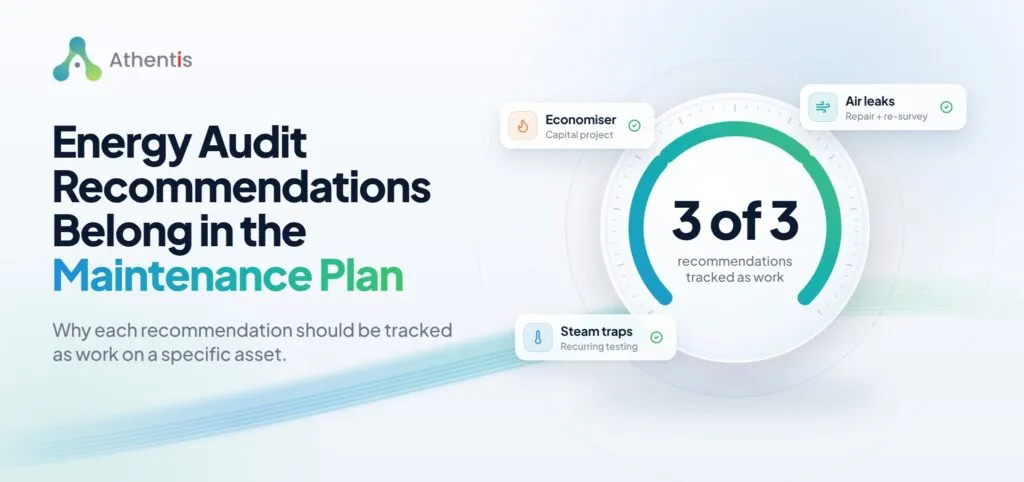
Why each recommendation should be tracked as work on a specific asset, so the savings last and the follow-up can be reported.
Picture a dairy that has just received its energy audit report. One recommendation, an economiser on the steam boiler, will need a capital budget. Two others, repairing compressed air leaks and replacing failed steam traps, are maintenance work that could start next week. Whether those savings are still there at the next audit depends on what happens after the first repair.
What the new energy audit rules ask for
The revised Energy Efficiency Directive, (EU) 2023/1791, bases the audit obligation on energy consumption. A company needs an energy audit at least every four years when its average annual consumption over the previous three years is above 10 TJ, roughly 2.8 GWh, counting all the energy it uses. Under the previous directive, mandatory audits applied to large companies, so this threshold can bring mid-sized companies with high energy use into scope for the first time. Companies that run an energy management system are exempt from the audit. Above 85 TJ, roughly 23.6 GWh, a certified energy management system is required by 11 October 2027.
After the audit, the company prepares an action plan with measures for each recommendation that is technically or economically feasible, and submits it to management. The action plan and the implementation rate of the recommendations are published in the company’s annual report, with protection for commercially sensitive information.
Cyprus wrote these requirements into national law with Law 92(I)/2026, published in April, and the first audits were due by 11 October 2026. For Greece, the European Commission said on 1 October 2026 that the directive had not yet been fully written into national law and formally asked Greece to complete the process. Large Greek companies already have to carry out an energy audit every four years under existing national law, and the directive shows what the updated rules are expected to include.
Plan the recurring work behind each saving
Guidance from the US Department of Energy shows why the savings from maintenance measures depend on recurring work. It notes that compressed air leaks often waste as much as 20 to 30% of a compressor’s output, and that fixing leaks once is not enough. Its steam guidance reports that where systems have not been maintained for three to five years, between 15 and 30% of the installed steam traps may have failed. The same guidance suggests testing traps at intervals from weekly for high-pressure systems to annually for low-pressure ones.
Link each recommendation to an asset
In the maintenance system, we suggest the following structure for energy audit recommendations:
- One record per recommendation. Use the reference from the audit report and link the record to the asset or system it concerns.
- Separate work for the repair and the check. The repair becomes a work order, and the recurring check becomes a preventive maintenance task with an owner and an interval. Record the recommendation as the reason for that task, so anyone reviewing the preventive maintenance plan later can see why it exists.
- A status for every recommendation. When one is judged not feasible, record the technical or economic reason.
- Readings from before and after. Where the asset or area is metered, keep these readings so the effect of the work can be compared with a baseline.
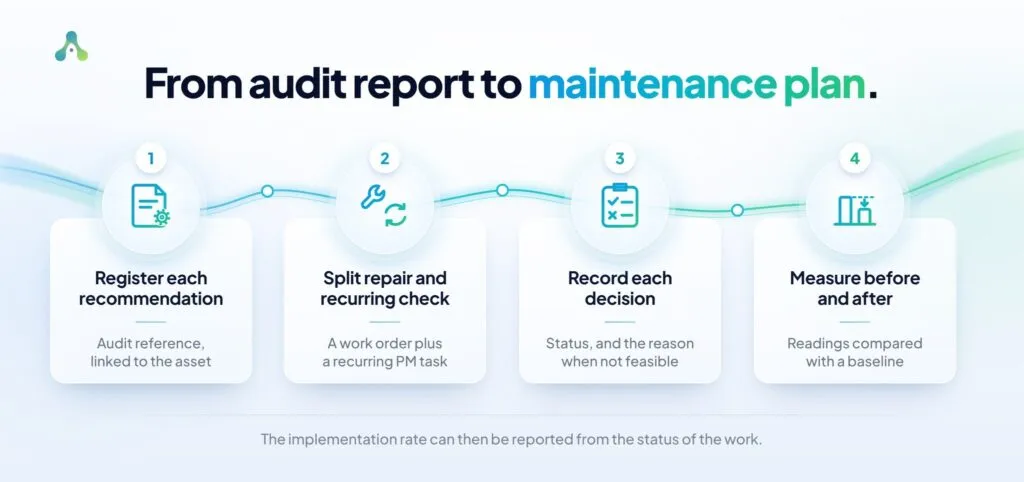
For the dairy, the leak repairs become one work order and the leak survey becomes a recurring task on the compressed air system, both linked to the same recommendation.
In Octave Attune EAM, a capital measure such as the economiser can be managed as a project in the same system. Where metering is available, the energy performance features can track an asset’s energy use against a baseline. The implementation rate can then be reported from the status of the work, and the next audit can start from a record of what was done since the last one.
At Athentis, we implement Octave Attune EAM for organisations in Greece and Cyprus. If your audit report has recently arrived, we can help set up its recommendations as tracked work on the relevant assets before the action plan goes to management.

