
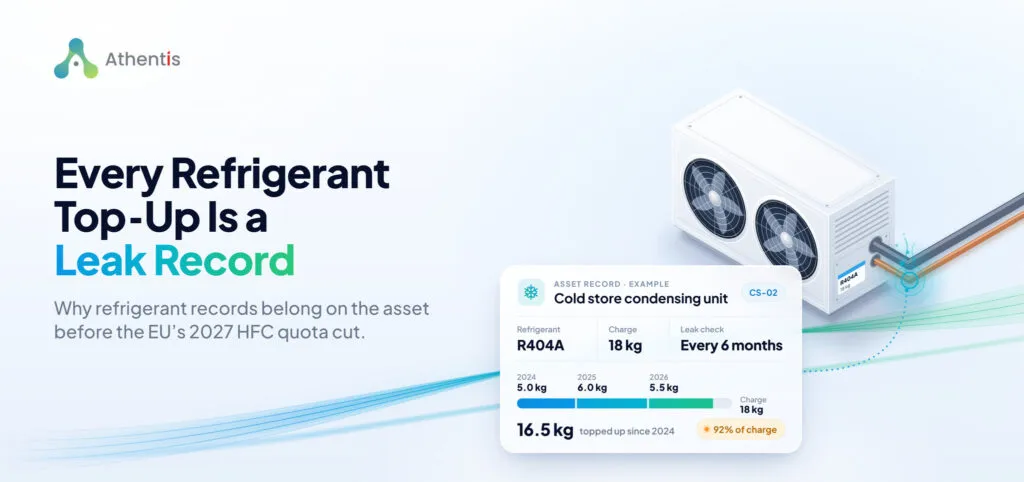
Why refrigerant records belong on the asset before the EU cuts its HFC quota by about half in 2027.
Take a cold store at a food distributor, where every summer the refrigeration contractor finds the system short of gas and tops it up with several kilograms of reclaimed R404A. Each service sheet looks routine on its own, yet over three summers the top-ups add up to most of the system’s charge, and the leak behind them has never been found.
What changes for refrigerant supply in January 2027
Each of those top-ups draws on a supply that EU rules keep tightening. The F-gas Regulation, (EU) 2024/573, applies directly in Greece and Cyprus. On 1 January 2027, its quota for placing HFCs on the EU market falls by about half compared with 2025 and 2026.
For R404A and other refrigerants with a GWP of 2,500 or more, servicing is already restricted. Since 1 January 2025, they may be used to service existing refrigeration equipment only if they are reclaimed or recycled, an exception that ends on 1 January 2030. Quarterly price monitoring carried out for the European Commission found at the end of 2025 that most producers no longer offered R404A.
What operators already have to record
Refrigeration and air conditioning equipment containing 5 tonnes of CO2 equivalent or more must be checked for leaks at least every 3 to 12 months, depending on the charge. For units labelled as hermetically sealed, the threshold is 10 tonnes. Installing a leak detection system doubles each of those intervals. The refrigeration units of refrigerated trucks and trailers are covered as well. A leak has to be repaired without undue delay, and a certified technician has to check the repair within one month.
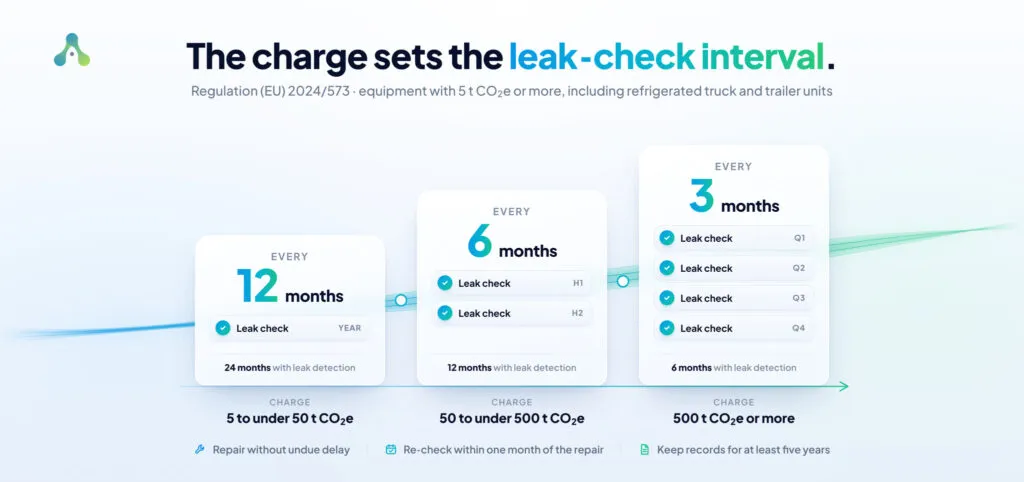
Each top-up must be recorded with its quantity and date, together with the results of every leak check and repair, and the records kept for at least five years. These obligations remain with the operator of the equipment, even when a contractor carries out the work.
Turn refrigerant records into a leak history
A service sheet describes one visit, and a trend appears only when every visit sits on the same asset record. In the maintenance system, that means four things:
- Refrigerant details on the asset. Record the refrigerant type, the charge in kilograms and its CO2 equivalent, so the leak-check interval follows from the asset record.
- Every top-up against the unit. Log the quantity added and the date, so the total added in a year can be compared with the charge.
- Repairs linked to their follow-up. Each leak repair should create the verification check that falls due within one month.
- A review threshold. Set your own limit for annual top-ups as a share of the charge, so that any unit passing it is flagged for review.
For the distributor, three summers of top-ups on one asset record would have shown a repeating leak by the second summer. The service sheets from those visits are enough to build that record now.
Use the winter to decide
In Greece and Cyprus, refrigeration and air conditioning work hardest in summer. That makes the coming months the practical time for repairs and replacements, starting with the units that have passed your top-up limit. For chillers, the options change on 1 January 2027. New chillers placed on the EU market from that date must use refrigerants with a GWP below 750, or below 150 for units of 12 kW or less, unless site safety requires otherwise. The limits apply only to new equipment, so existing chillers can keep operating.
In Octave Attune EAM, refrigerant details can be held on the asset record, with leak checks scheduled as preventive maintenance at the interval each unit requires. Top-ups and repairs go on work orders against the same asset. Cold stores and refrigerated trucks can then be reviewed in one place, with the records the regulation requires attached to each unit.
At Athentis, we implement Octave Attune EAM for organisations in Greece and Cyprus. If you are planning winter maintenance on cooling equipment, we can help you set up those assets so that every top-up and repair adds to each unit’s leak history.

